
Bastion
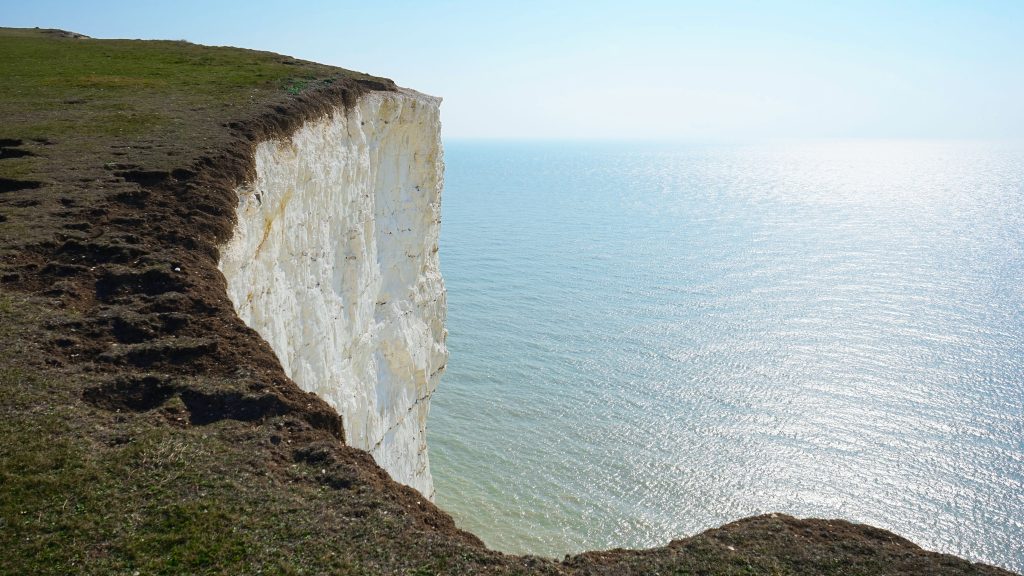
He recognized the cliffs as his last bastion of salvation.
By John G. Stamos

Bastion
John G. Stamos
He made it down the dark stairway and out into the bright summer sunlight with only the clothes on his back, a watch on his wrist, and enough bus fare for a one-way ride with transfers. No wallet. No ID. He’d left his shitty little efficiency unlocked, and as the late morning sun blistered his eyes and rippled his vision, he couldn’t come up with a reason why, even in this neighborhood, he shouldn’t have.
He was headed for the cliffs and wanted the 11:05 to start the series of transfers that would get him there. If he missed the 11:05, the 11:40 would be the next bus and he’d be out of luck. The bitch that always drove the 11:40 would never let him on. Two summers ago, she spotted him trying to sell a couple bindles of tar to a junkie and kicked him off. Threatened to have him busted if he ever tried to board again. Now, he regretted his lack of discretion. Should’ve made the deal at the rear of the bus where she never would’ve seen it going down. He recollected that there were some open seats back there, but he’d lacked the ambition to elbow his way down the aisle.
Two summers ago, the business with his eyes hadn’t started yet and he could still break into a run when he had to. Vivvie was always around and he was hustling enough junk where he could keep his head above water. Two summers ago, life was good.
Vivvie. He thought about her now while he wobbled down the sidewalk’s cracked and litter-strewn trail that would ultimately lead him to the bus stop. For months after the thing with Moray, he thought about her constantly. Every day, he’d remember how her brown skin glistened every time they made it. She’d get so damn slick with her own sweat and with his, and her dusky musk perfumed the air of his tiny apartment. The bed creaked and groaned with the weight of them and with the violence of their movement, and, for what seemed like forever, he couldn’t get the scent – couldn’t get the goddamned creaking – out of his head. How many days had passed that he could still hear that awful hunger in her voice when she pleaded for the junk he got her hooked on? And finally, the way she looked laying on her back in the alley. After Moray. Her eyes wide open, right leg folded up under her… the ribbons of its black and scarlet memory emblazoned the hollows of his days and nights until he’d shriek with the horror of it.
But those days and nights passed, as did the weeks and months, and he gradually lost interest. These days, Vivvie would only cross his mind once in a long while. Like she was doing now. He didn’t feel good when he thought about her, and he resented her for it. Her memory was an assailant. Its intrusion was a violation and he didn’t need it. Not on top of everything else.
It wasn’t this past December, but the one before, after Vivvie, that he discovered he could no longer completely close his eyes. The lids simply wouldn’t meet. He’d lay in bed at night and, against his will, scrutinize the cracks in the ceiling’s plaster by the light of the moon. His eyes dried out and, in a short time, became so bloodshot that the users he’d peddled to thought he was just as hooked on the shit as they were, though in truth, he never touched the stuff. His vision grew blurry and quickly deteriorated, and the following month (or the one after that), he noticed a distinct weakness in his hands and a trembling in his legs.
He knew something was wrong then, and he’d wished mightily that Vivvie were still there. She could’ve diagnosed him. Pointed him in the direction of some kind of treatment. She’d been a part-time nursing student at CCSF and a full-time cashier at the dollar store when they’d first met, and, with the might of crack and heroin’s inexorable pull on his side, he’d wrenched her from the stability of responsibility’s continuum and into a bottom-tier drug dealer’s nightmare of perpetual chaos. At the time, he’d convinced himself that she’d initially followed willingly, even eagerly, but these days, he was considering more and more the possibility that this was not the case.
Well, Vivvie wasn’t there when his body started turning on him, and she wasn’t here now. He came to the conclusion that there was some sort of progressive neurological shit going on. MS or Parkinson’s or that Lou Gehrig’s AL-whatever bullshit. He didn’t know exactly what it was, but he’d realized what it meant. As he knew it would, the drug money – what little of it there’d become – went away. He couldn’t get around any longer, and his vision constantly betrayed him. You didn’t need to be a genius to read the writing on the wall. His days as a low-rent pusher were over.
Stabbing sunlight penetrated the haze of his revery, and all at once, he recognized that he was seriously in danger of missing the 11:05 bus. His halting, uncertain gait permitted him only the most stultifying pace, and he still had almost three blocks to go. He glanced at his watch. 10:59. Goddamnit. He’d never make it. He ceased urging what little function was left from his wasting legs and stood where he was on the ruined sidewalk in the painful sunshine. And there made a decision. He’d chance it with the bitch 11:40 driver and try to board. What difference if she called the cops? Jail? Maybe. But right at that time, he thought he was certain it didn’t matter. He needed to make it to the cliffs.
At the stop, the bench was empty, and the rapture of sitting nearly caused him to swoon. From the vantage point of the bench, and with the transformative act of sitting as its impetus, he suddenly imagined his mind continuing on, even as his deteriorating body rested, as a trudging Luddite explorer soon to come upon some unknown fearsome machine at pulsing work amidst the pelting snows of a gelid landscape. And in this improbable place, he heard, above howling polar winds, one single word: Shatter…
Also from the bench, and when he half-squinted, he could now see the shithole apartment building where Moray used to run his operation.
Used to run. Moray was dead some six months now. Shot in the head by a rival distributor. Before he checked out, Moray was the guy in this neighborhood that locals like him got their junk from. He was a mean and crazy Puerto Rican who packed a Glock and carried a blade and doused himself with gallons of cologne. He never knew Moray’s real name, but he did know that he reeked constantly of b.o. and Prada and was insanely dangerous, and he knew, for some reason he could not fathom, that Moray had taken a liking to him. And it was his own misapprehension of Moray’s goodwill that would ultimately seal Vivvie’s fate, and, as it were, his own.
He continued to partly squint while he stared out across the busy street at the former headquarters of Moray’s empire, but soon partly blinked when he heard the chuff of a large vehicle’s air brakes. The 11:40 was idling before him. Already? He checked his watch. Right on time. What the hell was happening to him? Was he so lost in his daydreams that a half-hour could pass in the blink of an eye? (Partial blink of an eye, he reminded himself.)
The bus doors opened to admit him, the sole would-be rider waiting at the stop. He rose shakily to his feet and was soon standing before the open doors, awaiting the adjudication he knew was to come, and found himself holding his breath. But the face of the 11:40 bus driver, his old nemesis, after registering brief surprise, displayed no contempt that he could discern. Instead, she regarded him with an expression he could only describe as pity. She even smiled a little. No cops would be called on this day, he reckoned.
From his seat on the mostly empty 11:40, he watched Moray’s old building disappear from sight as the bus rolled on toward the first of the transfers that lay ahead, and he thought about Vivvie and her part in his plan to appease Moray.
When he first broached the subject with Vivvie of mollifying Moray and settling up without actually paying back any part of the two-grand he owed him, it was a weekday evening in late summer and Vivvie, who functioned at a surprisingly productive level despite the fact that she was, by that time, constantly strung out, was, as she did every night, cooking him dinner. She looked doubtful at first, but he was relentless. Finally, when he’d fully convinced her that she’d probably not need to go all the way with Moray and actually fuck him, she relented. He further assured her that Moray, after all, did in fact hold him in high regard.
He had the two-grand, was loathe to part with it, but stuffed it in Vivvie’s fanny pack anyway only as insurance, in the highly unlikely event that her café au lait exotic mixed-race charms alone would not suffice. It was a Friday night when he kissed her on the forehead, squeezed her hand, patted her ass, and sent her out into the night as his agent in the transaction with the ferocious but amicable Moray.
The next time he saw Vivvie, it was four hours later. He found her nude body lying in the alley behind his apartment, bled out. Her throat had been cut, her eyes were wide open, and one of her legs – the right one – was folded up underneath her. Moray had announced her presence to him by shouting from his car in the street outside his open window. Hey, amigo, I left you a little something in the alley. Thanks for the money, amigo, and for the pussy. You’re alright for a gringo!
The last trace of himself that Moray left behind as a memento that night wasn’t the squealing of his tires or the sound of his merry laughter fading into the city’s night as he drove away, it was the stench of b.o. and Prada that hung in the air over Vivvie’s body, laying as it was in the filth of the alley.
But this was not the last he’d ever know of Moray. On the contrary, in the face of losing Vivvie, his recognition of an elemental reality persisted. Above the horror and guilt he felt over her death, and his central part in it, the knowledge that life did indeed go on prevailed. Through the thickened hide of an anguish he believed he was experiencing, the need to eat and pay rent penetrated like a primitive spear. He knew he’d have to keep on dealing, and Moray was his main supplier…
As the bus trundled along during his second transfer, he watched through the window as the scenery changed first from urban gritty to suburban shiny, then from suburban shiny to pristine coastal. And while he watched, he considered the evolution of the thoughts he believed he was harboring about the wretched trajectory of his life. He examined, as he might a faceted gem or a tropical fish’s languid undulations in a quietly burbling aquarium, the ascension of his guilt and shame and horror over Vivvie’s unspeakable end (which ostensibly paced the progression of his own enfeebling neural deterioration) toward a summit of indifference and an incalculable resentment that should have proven to him even more terrifying but didn’t.
His trip to the cliffs on this day, which emerged as a mere nascent notion in the aftermath of Vivvie’s death, and coalesced as an unbreakable pact while his physical condition devolved, was now on the threshold of some monstrous transmogrification. In his mind, he once again became that trekking Luddite, lug wrench in frost-numbed hand, on a mission of destruction, on the brink of an assault on an unknowable thrumming and incongruent mechanism.
More chuffing of brakes. He roused himself and found he’d arrived at the cliffs. Though the spot he had in mind was substantially beyond his drop-off point here, where tourists and sightseers amassed to gape stupidly at the cliffs and the ocean beyond, his resolve in this matter did not waiver. The hike to the lonely point of jutting rock he’d months ago identified as the perfect choice for the fulfilment of his destiny would be long and slow and painful. His deadened legs and traitorous eyes ensured this fact. But he plodded forth.
When he finally reached the promontory, his legs would no longer support him. He dropped onto his back and the contact with the scabrous terrain savaged his tortured nerve endings in such a way as to wring from him an anguished bellowing. The sound was lost in the buffeting winds that assailed the cliff, and even he, as its source, couldn’t hear it. But that bellowing – the act of it – seemed to dislodge something in him. He rolled onto his side, faced the sea, and found that the cliff’s fatal drop was within his arm’s reach. At this moment, the true nature of the machine in the snows was revealed. In his mind, he brought the frozen lug wrench down with destructive force, and the chugging contraption broke into a thousand scattering, steaming fragments. And in that instant, he knew all he’d ever needed to know. He knew everything.
He sat up, then stood. But he did not approach the precipice. He instead turned away from it. And took a tentative step in the direction from which he’d come. There would be more junkies. There would be other Morays. There would be meds. And, yes, there’d be other Vivvies…
He took another step away from the cliff’s edge, back, the way he came, and, if he’d been able, would have kicked himself in the ass for not bringing enough dough for a roundtrip bus ticket.
“Bastion” ©2026. John G. Stamos and The Renaissance Garden Guy
Featured image photo credit: Mike Bird.
John Stamos is a writer and is co-publisher of The Renaissance Garden Guy. His work has appeared in a number of publications including, most recently, A Man for Some Seasons, Splice Today, and, of course, The Renaissance Garden Guy. He is married to his multitalented sweetheart, the mycologist and writer Ann Simpson-Stamos.


The Renaissance Garden Guy is a participant in the Amazon Associates Program. As an Amazon Associate, The Renaissance Garden Guy earns from qualifying purchases.
Additionally, The Renaissance Garden Guy is a participant in the Bluehost, SeedsNow, and Hosting.com (formerly A2 Hosting) affiliate programs. The Renaissance Garden Guy earns a fee/commission each time a visitor clicks on an ad or banner in this site from one of these companies and makes a subsequent qualifying purchase.
Please click here to view The Renaissance Garden Guy Disclosure page.

