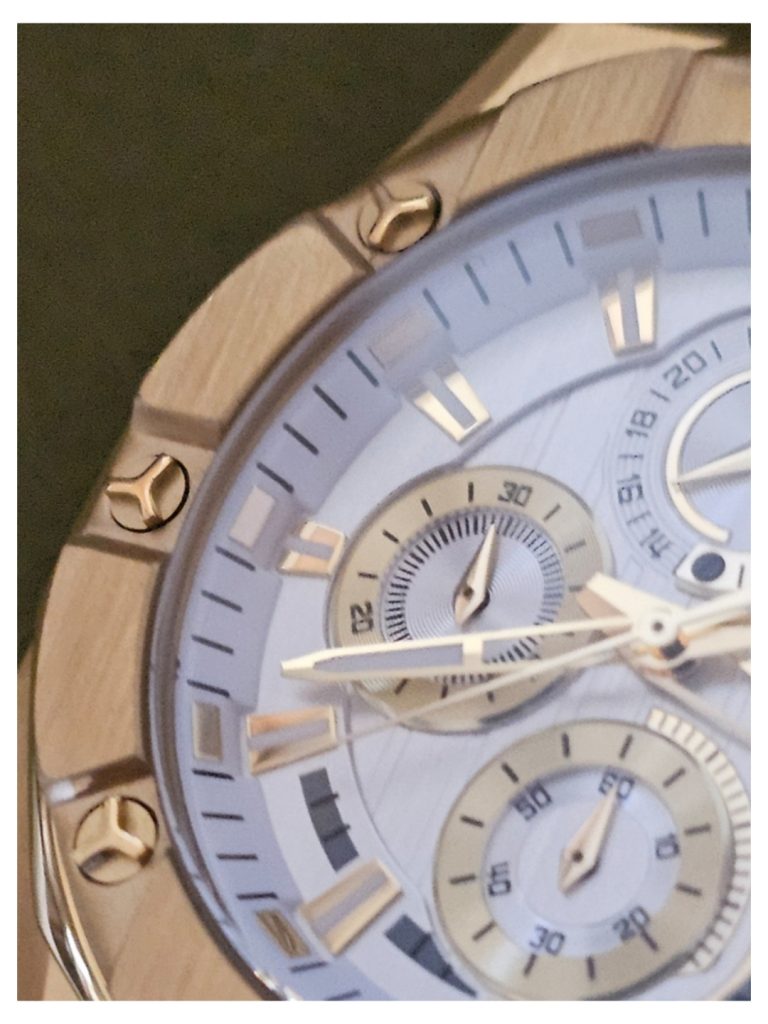

"Time and tide wait for no man... "
“Time and tide wait for no man… ” Nobody writes like Chaucer these days, and they don’t build watches – or men – like they used to.
By John G. Stamos

I thought the snippet of Chaucer’s line was appropriate for this particular discussion of men’s accoutrements…
Time marches on, and the world, and everything in it, changes. The featured image of this short piece is a shot of a beautiful gold wristwatch given to me as a Christmas gift (our final Christmas together before her passing) by my life partner, Dee Dee. The dynamic of the giving and receiving of this precious gift encapsulates the whole point of this particular bit of writing. Smartwatches are the timepieces people wear nowadays – high-tech PEDs that keep their wearers tethered to the internet and the digital supercell of constantly changing, constantly increasing nebulous data. But the gift of this gold watch – which boasts no high-tech capabilities beyond the precision movement that allows its hands to sweep across its face and accurately and faithfully report the time and date – is a notion from another time. My admiration of the piece, and Dee Dee’s admiration of that admiration, issues from a shared mindset informed by our forebears, who came straight out of The Greatest Generation. Both of our fathers fought in WWII, made it home alive, and married our mothers. Then raised us. Men who wore time on their wrists, so they knew of the hour at any time of the day or night, fulfilled their responsibilities to their wives and their families. The passing of those hands across the numerals on their watch faces served as a constant reminder of each and every aspect of those responsibilities, which they proudly took on and gladly fulfilled. Time to go to work. Time to pick up the kids from school. Time to go to church. Supper time. Those capable hands could be wrapped around a steering wheel, a pipe wrench, or a Thanksgiving carving knife, while the wristwatch’s own hands chronicled the elapsing trajectory of a life being honorably lived.
And if a man’s wristwatch made a fashion statement, even better. It was, after all, a vessel of the passing hours, the ark of a ceaseless and inexorable covenant. Wristwatches were often designed with a beauty refelective of their import. But ultimately, these devices, as gorgeously crafted and fashionable as many may have been, were worn on those thick wrists for one main purpose: to keep their wearers steadfast and true. The wristwatch connected its wearer to his obligations, familial and otherwise. And in the case of Dee Dee’s dad and mine, and others from their generation, those obligations were taken seriously and always honored. A man’s wristwatch was the embodiment of its wearer’s integrity and sense of responsibility.
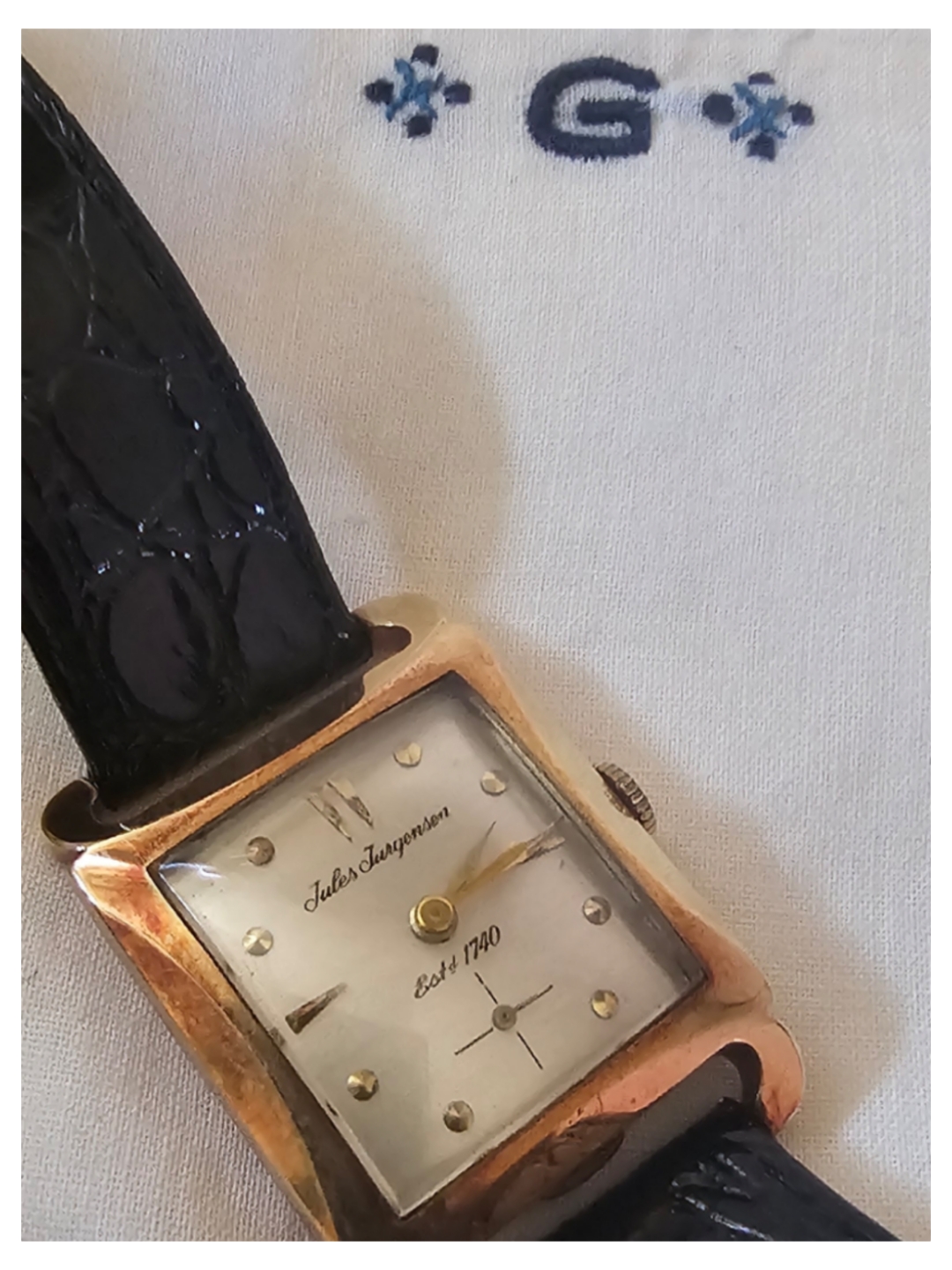
The dawning of the digital age has brought with it a new aesthetic and new sensibilities with respect to the passing of time, and humankind’s reaction to it. The minimalist appearance of a smartwatch, in stark contrast to the overt celebration and ornamental manifestation of mechanical hour-keeping craftsmanship inherent in a traditional wrist-worn timepiece, belies the device’s technical capabilities. Smartwatches are wrist-worn computers. Their appearance is of nugatory consequence. It’s what they can do, where they can lead, that is of the utmost importance to their wearers. The digital vistas that gape just beyond the keyhole of a smartwatch’s screen (they have screens, not faces) hold their wearers – their users – in what can only be described in some cases as unassailable thrall. The notion of wearing time – and time alone – as a tangible code of ethics and duties (and, perhaps to a lesser extent, a fashion statement) on one’s wrist is as far removed from the collective mindset of today’s smartwatch movement as a crater on the dark side of the moon.
Thinking is entirely different today than it was during my father’s time. This is not unexpected. Throughout humankind’s history, advances in technology have wrought corresponding cuItural and moral changes. But I do wonder how different the actual wiring of the modern mind is from that of Dee Dee’s father’s mind, or from my dad’s. Or, for that matter, from my own. What matters to today’s conscious mind is what can be gotten – information, entertainment, investment, and how much, what kind, how fast – by virtue of the technology worn on a wrist. Human reactions to a portable microprocessor’s delivery of sensory input have become reflexive. It’s almost as if the technology has become a physical extension of the human body. Is the architecture of the human brain evolving right along with that technology? Where there was once emotive impetus associated with the wristwatch’s simple telling of the time to its wearer, there are now biomechanical/biochemical reactions from modern individuals to the streams of digitally generated visual data. A smartwatch screen stimulates its wearer at the neural level.
Are there any more days of watching the scenery from the window of a train trundle by, while the time of the miles rolling out ahead and behind is marked by a simple glance at the hands of a wristwatch? Is there time left for the assurance that the passing minutes, marked by the “tick-tick-tick” of that reliable piece of watchmaker’s craftsmanship, bring the weary traveler closer to his loved ones waiting for him at home? Do such assurances matter anymore? What does time measure today?
With respect to these questions, I am certain of only two things : 1) Time definitely does not wait for anyone, and 2) They don’t build wristwatches like they used to.
See you next time.
Publisher’s note: “‘Time and tide wait for no man… ‘” first appeared in A Man for Some Seasons in 2024.
“‘Time and tide wait for no man… ‘” ©2024. John G. Stamos and A Man for Some Seasons, ©2026. John G. Stamos and The Renaissance Garden Guy
John Stamos is a writer and is co-publisher of The Renaissance Garden Guy. His work has appeared in a number of publications including, most recently, A Man for Some Seasons, Splice Today, and, of course, The Renaissance Garden Guy. He is married to his multitalented sweetheart, the mycologist and writer Ann Simpson-Stamos.


The Renaissance Garden Guy is a participant in the Amazon Associates Program. As an Amazon Associate, The Renaissance Garden Guy earns from qualifying purchases.
Additionally, The Renaissance Garden Guy is a participant in the Bluehost, SeedsNow, and Hosting.com (formerly A2 Hosting) affiliate programs. The Renaissance Garden Guy earns a fee/commission each time a visitor clicks on an ad or banner in this site from one of these companies and makes a subsequent qualifying purchase.
Please click here to view The Renaissance Garden Guy Disclosure page.


I don’t wear a watch anymore, as I’m retired, but I do remember wearing several over the years. Some I wore for style, and others I wore because each had a certain family history attached to it. While those I wore for style have gone on to new lives elsewhere, I still own the watches associated with family histories. My favorite one is the pocket watch my grandfather gave me shortly before he died in 1978. He’d owned it for many years. A few others remain with me as well, and looking at each of them triggers a particular memory that’s either happy or somber.
Thank you for reading the piece, Scott, and for relating your thoughts about the watches in your own collection. I can understand how important your grandfather’s pocket watch remains to you. These devices – particularly those of heirloom status such as your grandfather’s – have such evocative power that each seems to become both a physical and spiritual extension of its owner. I firmly believe that when you carry your grandfather’s pocket watch with you, you’re carrying also with you a part of your grandfather himself. Thanks once again, Scott.
Beautiful story! I always appreciated vintage classics …
The craftsmanship, the hand-finished, durable movements of vintage watches are incredible. they were built for longevity rather than mass production. Also, they are wearable art that tells a story.
Thank you so much for reading this one, Roxxy. And thank you for your kind and lovely thoughts. I so appreciate your take on the aesthetics of those remarkable old timepieces. You’re absolutely right. Their engineering and construction are peerless, and every line, surface, and tick of their hands do indeed relate the histories of their wearers. Thanks once again for reading the piece, Roxxy, and for your wonderful thoughts on the subject.
Great reflections on changing times and timepieces! You struck a lot of familiar chords for me in this one!
I’m glad it resonated with you, Lisa. Thank you so much for giving it a read. It’s remarkable how a wristwatch can function not only as a means of measuring time, but also as a gauge for cultural/societal change. Smartwatches, I believe, lack the ability to perform the latter role because they lack not only the benefit of historical precedence, but also the benefit of perspective. By virtue of their very engineering, they’re tools of immersion. Thanks again, Lisa.
Your father’s watch is a timeless classic. It seems that time used to move at a slower pace. I wonder if watches like your father’s mark the passage of time at today’s rate or if they track time at that rate I remember from the past?
Geez, Kevin, this is such a fascinating concept. I honestly think there’s a story in there somewhere. I do know exactly what you mean. The world, and everything in it, seems to move at an ever-faster pace, but when we were kids, time passed in sweetly slow fashion. At what point did things speed up? And did the world around us truly speed up, or was it just our perception of it as we aged that made the time fly? This is heavy stuff. Like I said, there’s a story here. Thanks for reading the piece, Kevin, and for these excellent comments.
Beautiful short piece relatable to many – including myself.
I very much appreciate your ability to write on many subjects. You are a Renaissance man not only the Renaissance Garden Guy.
Thank you for reading the piece, Rick, and of course, thank you for the incredibly kind compliment. Your thoughtful observations and generous praise bring up an interesting point: When I first began publishing The Renaissance Garden Guy, I’d always known that I wanted to feature here the work of writers from many backgrounds and areas of expertise, with gardening as merely one aspect of The RGG’s content, as well as its general contextual backdrop and loosely-based theme. It was always the “Renaissance” part of the publication’s title that I felt would reference most accurately the diversity of The RGG’s content payload. Your observations, once again, are highly relevant and, once again, greatly appreciated. Thank you so much, Rick.