
Clash of the Control Titans
What if you put two people with an overwhelming need to control the environment in the same space, but their respective ideas of “a place for everything and everything in its place” mean something entirely different? There may be underlying forces so powerful that we find a way to live in a way we once thought was unlivable, that we find a way to de-escalate the Clash of the Control Titans.
By Lisa Louis

From early childhood, I felt compelled to count things. I counted every word in the word lists on the endpaper pages of my copy of Dr. Seuss’s Hop on Pop (the original copy of which I still own). I counted every colored dot on the endpaper pages of Put Me in the Zoo (Robert Lopshire) from my “Beginner Books • I Can Read It All By Myself” collection. If I lost count, I had to go back to the beginning and start again. I did this every one of the hundreds of times I read those books.
I counted steps as I walked from Point A to Point B. If I lost count, I would go back to the beginning and start over. If something prevented me from the redo, I created some sort of substitute mental device so that losing count didn’t bring me bad luck.
I avoided stepping on cracks in sidewalks well into adulthood. “Don’t step on the crack or you’ll break your mother’s back” was a lighthearted game with my childhood friends, but I actually felt I would jinx the world if I stepped on a crack. On the rare times that I did, I concocted a corrective step that would erase the error, like going back and starting again.
I thought everyone “had a thing about numbers” like I did. To my mental health detriment, growing up in a western society meant that I needed to have everything in even numbers, and to have things be symmetrical. I was driven to distraction when there was not an even, balanced set of objects.
I was surprised to find out from conversations with friends that not everyone’s life is dictated by imposing a number system on everything. I did not realize how restricted my mentality was until I moved to an entirely different cultural environment.
Having grown up in the United States, many aspects of design and aesthetics stemmed from European traditions. Think of historic gardens of France and England. They are usually arranged in some sort of symmetrical form, with easily identifiable patterns. There are measurable starts and endings to forms and shapes.
My life changed remarkably when I moved to Japan upon graduating from college. My mental system of counting and making sure there was an even, symmetrical set of objects or actions was tossed upside down and backwards.
In Japan, odd numbers take precedence, and asymmetricity is a primary design element. Buy a set of teacups and saucers as a wedding gift in the U.S. and you will have options for a set of four, six, or eight. Buy a set of teacups in Japan, and you will have five cups.
Visit a Japanese temple garden and you will experience the artful manipulation of nature, skillfully rounding corners, having odd sets of asymmetrical forms that appear as if nature had placed them that way. Is a bonsai tree symmetrical? It is not. It is cleverly designed to have branches of different sizes twisting in different directions, while creating a sense of balance overall within the asymmetricity. It is an enhanced manifestation of natural forms.
Living in Japan where my entire “even and symmetrical” control system had to be thrown by the wayside lightened a huge mental burden. This does not mean I overcame my compulsion to count and impose order on things, but my preference switched to odd numbers (especially prime numbers… there’s nothing better than a good prime number!), and I embraced things in asymmetric form. My need to impose numerical structures was still there, but odd numbers and asymmetric forms are much more forgiving than a system requiring even numbers in symmetrical form.
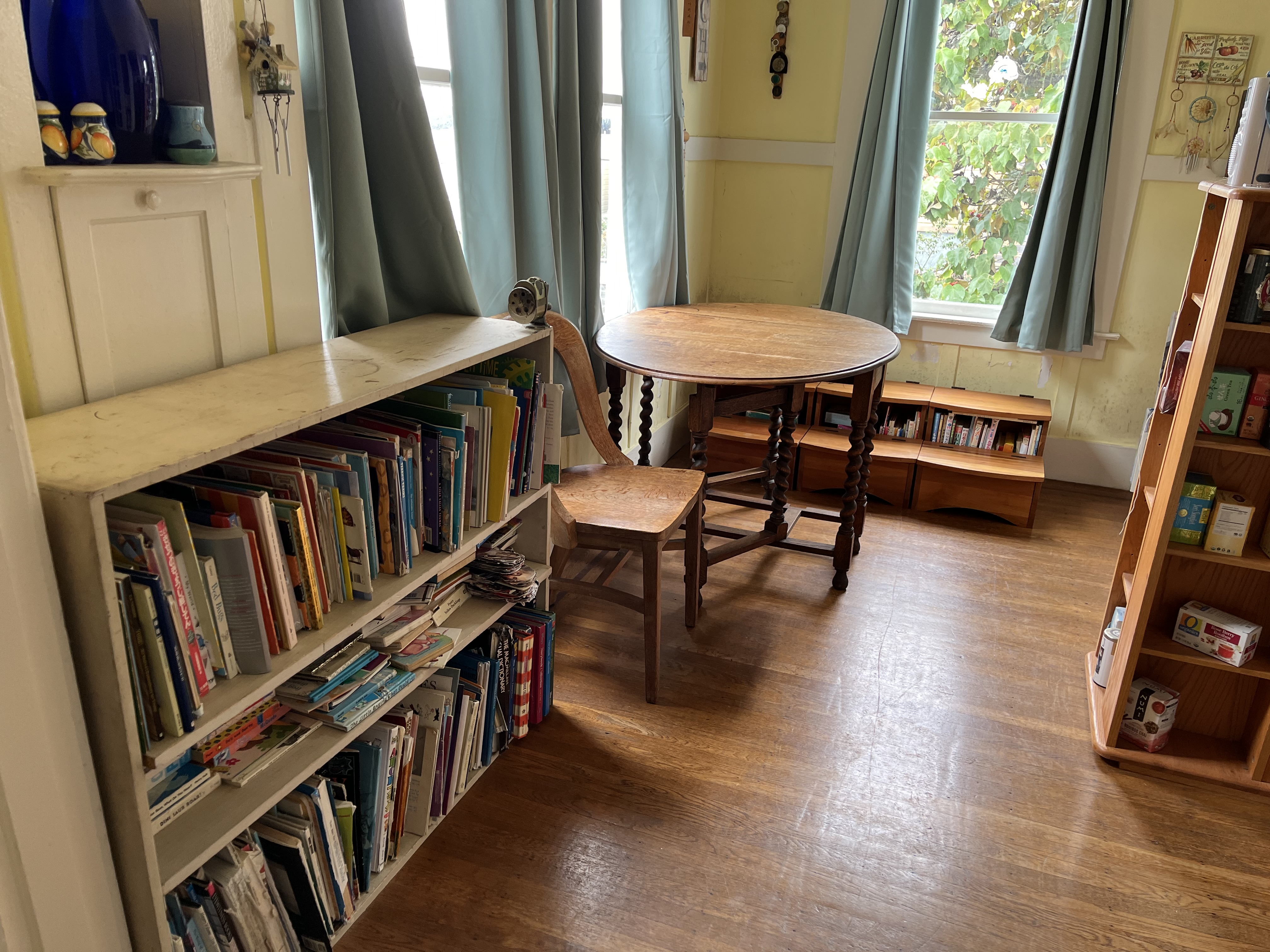
What does this look like in a living space? Though I was never diagnosed, many would say these traits sound like characteristics of OCD (obsessive compulsive disorder). In my case, it does not mean that every speck of dust is wiped away or that everything is clean and disinfected. It means that of the estimated two thousand books in my house, at one point, I could find any given book on a certain shelf level of a specific bookshelf. Books were variously organized by size, by type, by who gave them to me, or some combination thereof. I had multi-faceted organizational systems not only for books, but also for my extensive collection of music and movies, going back to the old days with cassette tapes and CDs for music, and VHS tapes and DVDs for movies.
In the years before I had kids, I enjoyed doing jigsaw puzzles as a sporadic treat, typically done in a frenzy on a Christmas or New Years Day, my rare quiet days. Organizing shapes and colors was entertaining but also a way to scratch that itch in my brain that needed to put things where they belong. God forbid that a puzzle piece ever went missing. One puzzle piece was lost for two years, and it bothered me every single day until it appeared in a clump of dust under a piece of furniture.
My husband once admitted to me that when I was upset about something like a missing puzzle piece and he reassured me by saying, “Don’t worry, we’ll definitely find it,” he actually had no do-or-die intention of finding it. His trick that was supposed to calm me never worked again.
Fast forward to my mid-thirties when I was mom to two young sons. Having one baby is enough to throw anyone’s baby-free life routine out with the bath water. Having a second baby really throws the normal sense of order into a tizzy. I no longer had the wherewithal to keep things in the same precise order as before, and the house started filling up with all sorts of baby clothes, toys and play equipment.
Breathlessly (and sleeplessly) guiding my boys along the escalator of infancy, preschool and beyond—with the huge additional emotional, time, and resource drain of an autism diagnosis for my younger son—meant that our once well-organized house swiftly started taking on hoarder house qualities. There was no time to sort and discard enough objects to stem the tide of incoming items as the boys grew.
Despite the clutter buildup, I could still find pretty much any book or music CD by instinct. As my sons got older, they started moving objects around, and I had to keep more of an eye out to maintain my sense of which books were where.
Our younger son’s autism diagnosis was revealed in stages as we recognized differences from typically developing children. He wasn’t talking understandably by age three, didn’t look people in the eye, and didn’t use typical gestures to communicate with people. These were the things that he had difficulty doing.
On the flip side, he had a driving motivation to move objects in his environment, including all the items I used to keep relatively organized. When he was still crawling and cruising along the furniture to get from place to place, I noticed that my hairbands from the bathroom drawer kept disappearing. It took us weeks to discover that our not-yet walking one-year-old was deftly transferring hairbands from a drawer to an entirely different room, into an antique Japanese tea cabinet. We were baffled yet impressed by his motivation and ability.
As he got older, this tendency became more powerful and sometimes became a source of meltdowns and frustration when he couldn’t get the objects in his world to be the way he imagined them in his mind. With the abundance of bookshelves in our small house, books became easy target objects for him to manipulate so he could assert some control over his world. Unlike me, he was later officially diagnosed as having OCD.
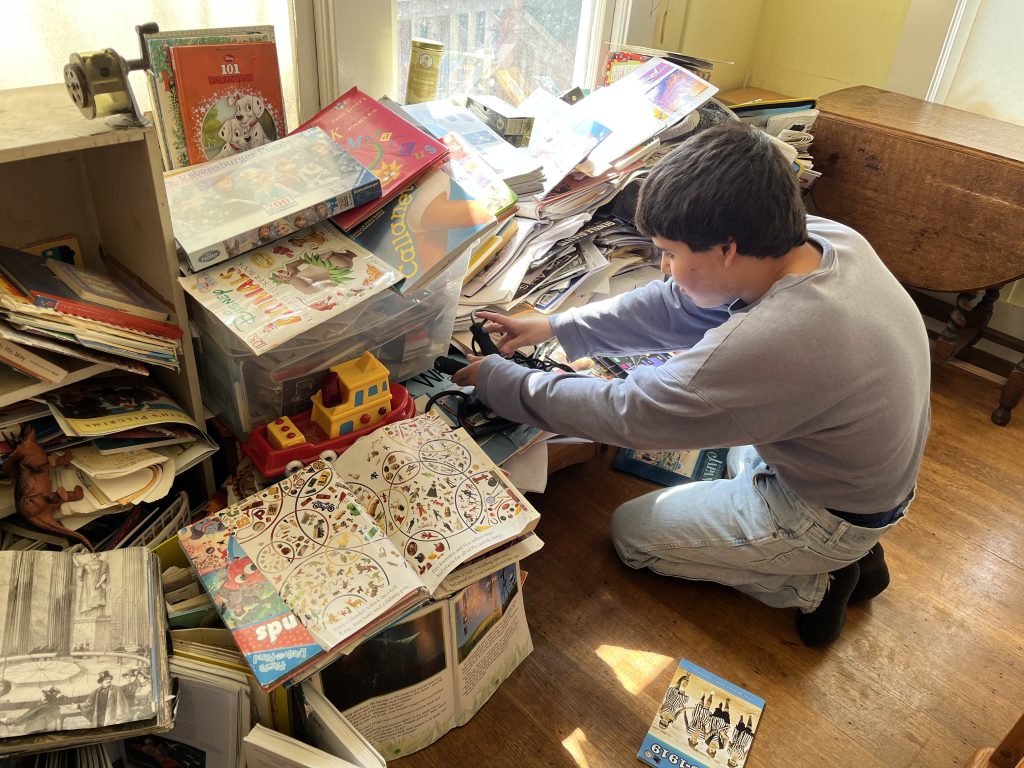
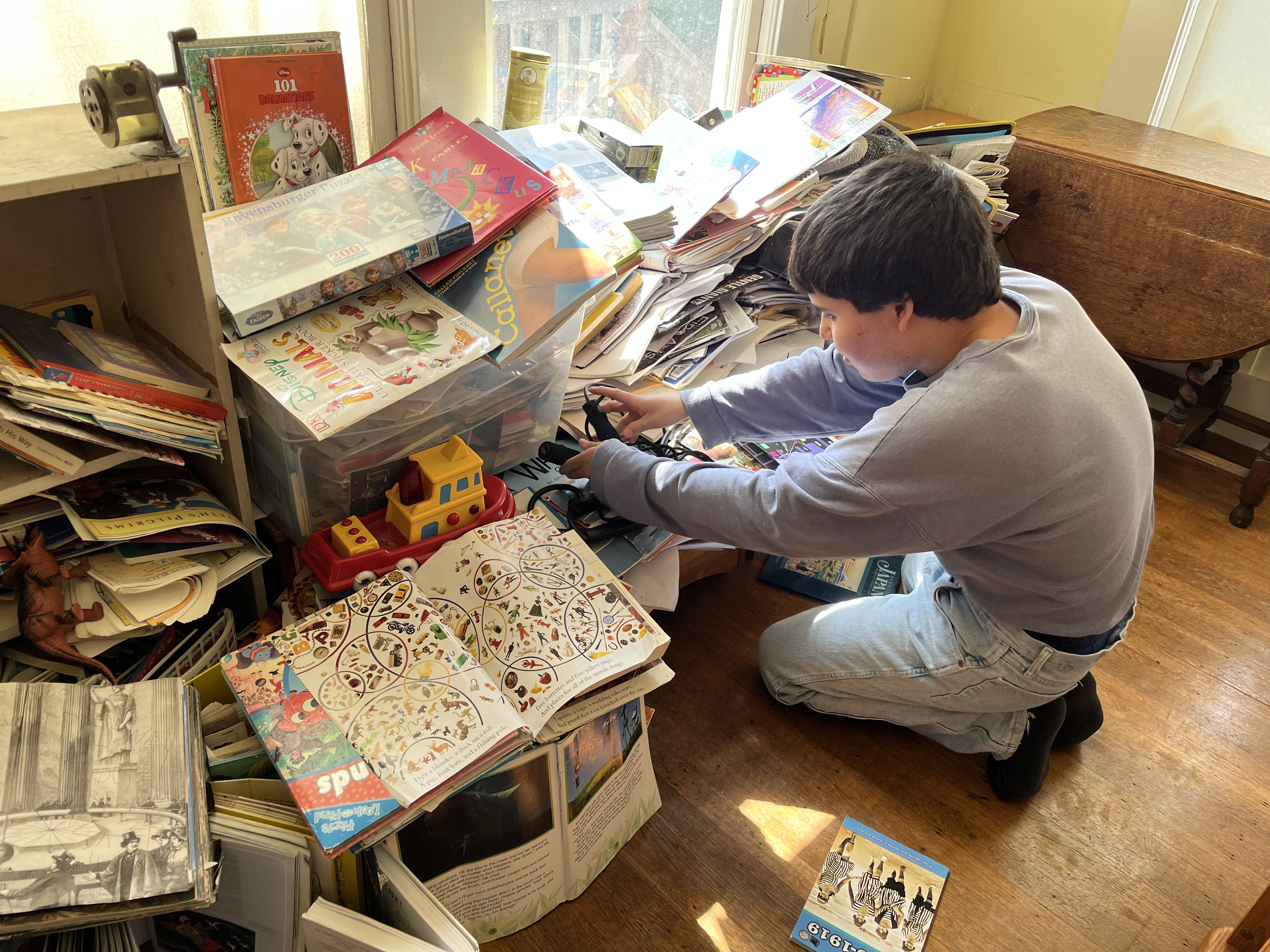
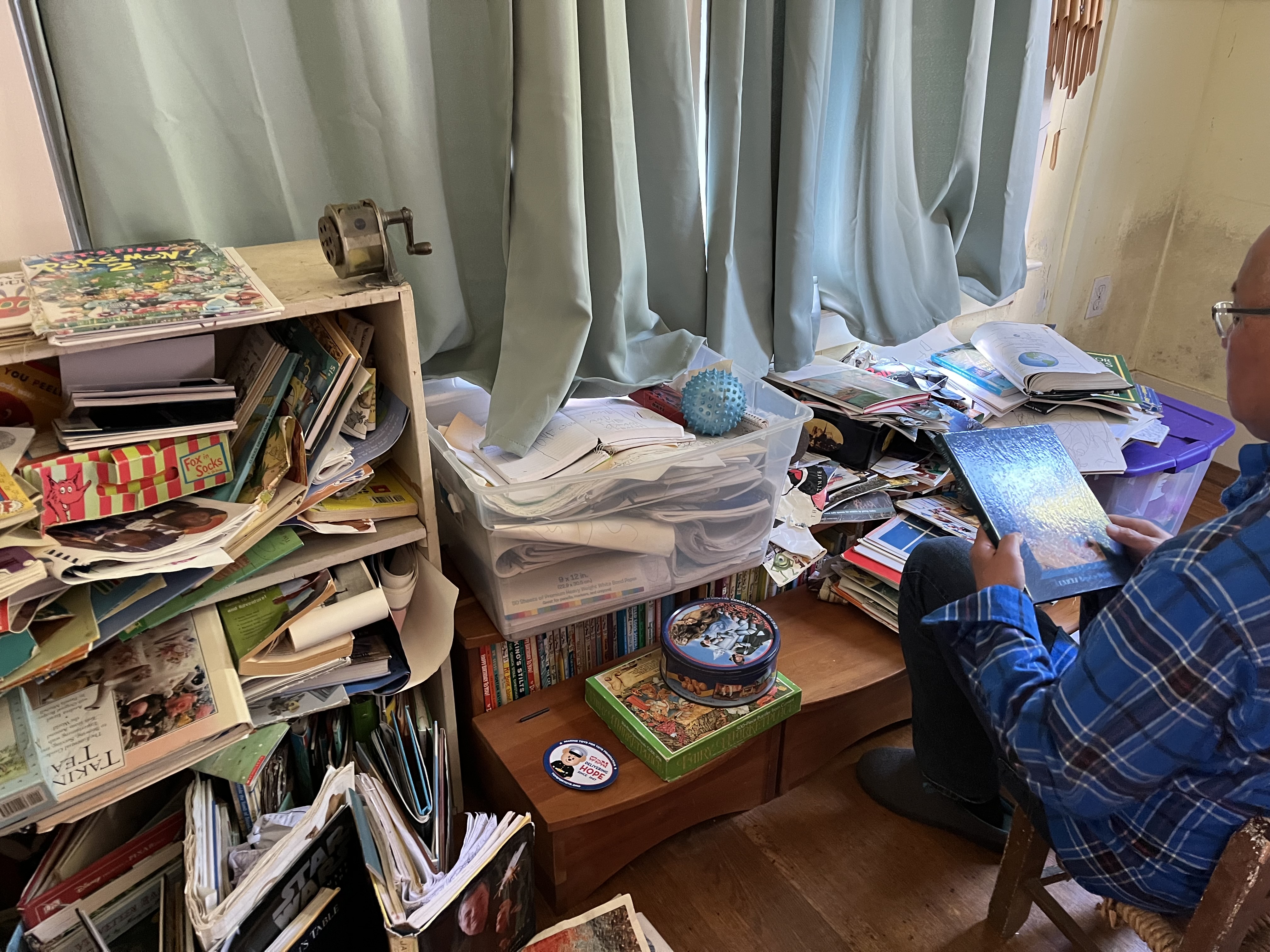
Over time, my unofficial yet established system of book organization was dismantled. What was worse, my son decided that books should not always be lined up side-by-side, but instead be jammed into the shelf in layers in an overlapping V-pattern with bindings as the back center line. Even worse, some of the books were jammed over each other with the binding bent backwards, interior of the book facing outwards, binding sometimes damaged, and pages sometimes squished or torn. Sigh.
The movie DVD and music CD collections underwent another reorganization according to his preferences. Keeping him occupied on rainy days when we went to indoor places like a shopping mall often meant letting him look through the movies on the shelves at video stores when such establishments still existed. Store staff kindly let our son sit in the aisle and look through Disney titles, and we in turn felt obliged to buy movies we didn’t really need (with thousands of dollars spent cumulatively over the years).
Imagine my dismay when I discovered that he had started switching the contents of movie DVDs and music CDs. There would be three DVDs squinched tight into a case, not one of them being in the case it belonged in. The same started happening with music CDs. Not only were there dozens of mismatched cases and disks, but some of the disks were scratched. Sigh again.
We eventually moved the DVDs and CDs to our attic office area, making it truly hoarder-house-central. Hiding items away from our son to protect some of them became a competitive sport which left us unable to find anything after we hid things in a frenzy in stacks in the attic.
We could not move all the bookshelves, so I learned to cope with the heart-sinking feeling when I saw that my son had jammed treasured books together and damaged them, some of them out-of-print tomes with extra emotional and/or monetary value.
Treasured objects I’d collected from around the world, displayed in various locations with pride as part of our home décor, would suddenly be on his “no!” list, and he would climb precariously on a chair to reach an antique Balinese mask to take it down, for one example. Our walls and display areas have become increasingly bare.
Then there were the puzzles. We had quite a collection of jigsaw puzzles for the boys, ranging from 30 pieces to 300 pieces. Some shelves around the house were mixed purpose, holding both books and the colorful puzzle boxes. I started noticing my son opening and closing the puzzle boxes, and worried about pieces going missing. I bought sealable plastic bags to securely enclose the pieces within the boxes so they would not fall out and get lost.
It is not possible to truly supervise someone 24/7. In times when one of us parents was in the attic office working and the other was in the kitchen cooking, my son had free rein amongst the shelves. It was a double whammy shock to find random puzzle pieces, taken out from the sealed plastic bags when no one was looking, tucked behind a row of books on a shelf, squished between pages, or shoved under a sofa cushion. I now have a “lost pieces” bag on my desk where I keep the random puzzle pieces found in the back of a closet or under a bed, waiting for “someday” when I am able to find out which puzzle the random puzzle pieces strayed from, and return them to their rightful place.
I am no longer able to be as organized as I used to be, nor do I need to be. It has, however, been a huge adjustment figuring out how to coexist with someone whose instinct to control how and where objects are kept is as powerful as mine. The problem is that his idea of where to put things often clashes dramatically with mine.
Having things out of place from how we imagine they should be dysregulates our nervous systems. Conversely, organizing objects in their proper places helps regulate our stressed systems. In our house, we have become moderately successful at coexisting peacefully despite the clash of opposing organization instincts.
Someone in the special needs community once asked us if our son had seen a psychiatrist about any of his behaviors and issues related to being autistic. “What good would it do to have an almost nonverbal person interact with a psychiatrist?!” I thought, dismissing the idea as foolish.
Eventually my son’s very astute primary care doctor suggested we check in with a psychiatrist who was well versed in autism and developmental disabilities. Despite our skepticism, we went ahead and had a video visit. We described our son’s behavior and interactions because he is not able to articulate sophisticated ideas verbally. To my surprise, the psychiatrist revealed a simple truth that seemed obvious in retrospect.
“Sean is a person who wishes to make choices and decisions in his life like the rest of us. Because of his circumstances, someone else decides when he gets up, what he eats, what he wears, where he is going to spend his time and what activity he’ll do there, when he takes a shower and when he goes to bed,” she stated. “Everyone wants to have some level of control over his life. Moving and manipulating objects is one way for him to do that.”
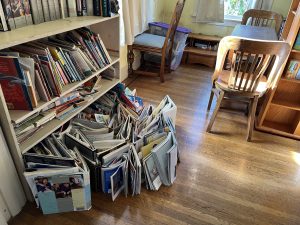
What a hugely helpful revelation. I have learned to choose my battles. I accept that sometimes my stubborn nature wins out for the greater good, and sometimes his wins out because he has a right to make some decisions about his environment. Finding a peaceful mid-range has made life much less frustrating, though I still get upset when he moves my entire collection of cookbooks and squishes some of the pages in the process. Life is an evolving process of learning how to interact, and my son has taught me as much as I’ve taught him.
Have readers experienced character clashes at home or work? Hopefully you’ve been able to work out a peaceful mode for coexisting!
“Clash of the Control Titans” ©2026. Lisa Louis and The Renaissance Garden Guy
Lisa Louis is a San Francisco based author. Readers can check out her website, HikingAutism.com, to enjoy the Insights blog posts for weekly uplifting messages, look at the ever-growing list of Hike Notes to see the almost 230 hike descriptions, and enjoy over 2,500 nature photos in the photo galleries under the hikes. Lisa and her family lead other special needs families on monthly hikes in the San Francisco Bay Area in collaboration with the Autism Society. Her upcoming book Autism Outdoors: A Guide to Finding Calm in Nature is scheduled for publication by Globe Pequot/Falcon Guides in early 2027. Readers can find Lisa at facebook.com/HikingAutism, twitter.com/HikingAutism, instagram.com/lisalouis777, and HikingAutism.bsky.social


The Renaissance Garden Guy is a participant in the Amazon Associates Program. As an Amazon Associate, The Renaissance Garden Guy earns from qualifying purchases.
Additionally, The Renaissance Garden Guy is a participant in the Bluehost, SeedsNow, and Hosting.com (formerly A2 Hosting) affiliate programs. The Renaissance Garden Guy earns a fee/commission each time a visitor clicks on an ad or banner in this site from one of these companies and makes a subsequent qualifying purchase.
Please click here to view The Renaissance Garden Guy Disclosure page.



Written with much love, heart and soul. Communication and understanding are always vital. Thanks for sharing your experiences in this wonderful article.
Thank you so much for reading the piece, and for your kind comments, Rick!
This article reminded me that I always do certain things without really realizing that I’m doing them. It must be very difficult for the author to find balance between her sense of organization and that of Sean’s, but she definitely does find it. That balance must come from a mother’s love.
Thank you very much for your kind comments, Kevin. I’m very interested to hear readers’ reflections on their own habits!
This is a wonderful article… illuminating, honest, and even funny. Makes me mentally chronicle my own small, internal control mechanisms. And I too live in a house of books, so I profoundly appreciate the author’s hard-won peace with letting go of some of her hard and fast rules. I so appreciate this piece.
Thank you for reading the piece and sharing your thoughts, Alison. I’m glad to hear from another person who lives in a house full of books and understands my struggle! Thank you for the comment!
This is a wonderful and fascinating piece, Lisa! I actually could not help glancing several times at my own bookcases while reading this and seeing my own patterns of behaviour in how I organize my books. And don’t get me started on my cups and mugs! Thank you for sharing such terrific insights.
Thank you for reading the piece and sharing your thoughts, Ann. Now you have me thinking about my mugs and cups. They could use a reorganization, ha ha!