
Please Don't Eat the Horseradish: Growing Armoracia rusticana as an Ornamental Garden Perennial
Please don’t eat the horseradish… at least not until you try growing it as a beautiful ornamental garden perennial first.
By John G. Stamos

Table of Contents
Introduction: Please Don't Eat the Horseradish (Buck the Status Quo)
The Popularity of Prepared Horseradish: It Spreads like Wildfire
It’s an undeniable fact that horseradish, as a condiment, goes great with lots of foods. In its prepared form, it’s chopped or grated and mixed with vinegar and other seasonings, and it’s smeared on everything from hot dogs to fish to salads to roast beef. Prepared horseradish adds that unmistakable hot and tangy zip to your chow that whips open your nasal passages and makes your eyes – and mouth – water like a leaky sieve. It might be considered an acquired taste, but it’s one that legions of the ingestion-minded hold near and dear to their hearts and their Kleenex boxes.
In the condiment world’s arena, horseradish occupies a place of honor. Gourmands in planet-girdling number adore its one-of-a-kind taste (and its singular effect on their oral cavities and mucus membranes), and there’s likewise a massive global industry in place that’s ceaselessly engaged in the assurance of its presence on grocery store shelves, restaurant menus, and home refrigerators everywhere.¹ From companies that cultivate it, to those that process and bottle it, the commercial impetus behind their promise to flavor afficionados around the world that they’ll be getting their horseradish on is a mighty one.
Rooted in Flavor and (Potentially Damaging) Heat
So, horseradish, as a condiment, is a globally popular food-dresser-upper. But it’s also a durable – and quite attractive (more on this a little later) – perennial plant. In fact, Armoracia rusticana, aka Horseradish (or simply “horseradish”), as a plant, and as a crop at large, is the very source of horseradish as that globally popular condiment. And, in what specific part of the Armoracia rusticana plant does that wild horseradish flavor find its source? Where does that impossible-to-mistake-for-anything-else taste impact lurk? You guessed it: in the horseradish plant’s roots.
As in the case of its native Asian cousin, the wasabi plant, Eutrema japonicum (in the same plant family but of a different genus and species),² the horseradish plant’s root system is indeed where its sinus-clearing zing comes from. Sinigrin, a sulfur-containing compound known as a glucosinolate, along with an enzyme called myrosinase, are always present in horseradish plant roots. When those roots are chopped, shredded, grated, etc., and subsequently find themselves in the presence of water (as in your saliva), myrosinase removes the “glucose” part of the glucosinate sinigrin and converts it to a chemical compound called allyl isothiocyanate.³⁻⁴ Not only is this blazing compound hot, it’s also a lachrymator, which means that it doesn’t just set your mouth (and head, upper respitratory system, etc.) on fire, it causes your nose to run like a pair of nasty nylons and your tears to flow like a mountain stream.⁴
Once it’s coated the inside of your mouth, allyl isothiocyanate and its particular chemical properties stimulate, and are managed by, a cellular receptor called TRPA1, which is a gene known as an ion channel, and which we humans and our fellow mammals all possess.⁴⁻⁵ The presence of allyl isothiocyanate, and the TRPA1 receptor’s reaction to it, is the sensory combo that blows your nose and your mind, and makes prepared horseradish so horesradishy hot when you shovel it into your piehole. And “prepared” is the operative word, because if you were to chew grated/chopped/shredded horseradish root in unmitigated fashion, that allyl isothiocyanate would get hotter and hotter the more you chomped down on it, and it would literally scorch the hell out of your mouth and clear your head of mucus, soft tissue lining, and all rational thought. So, the burning heat in any prepared horseradish recipe is always mitigated (to varying degrees per each recipe) by the presence of a certain acidifying agent. And that agent is none other than… vinegar. The acidity of the vinegar present in a given horseradish recipe interrupts the conversion of sinigrin to full-on allyl isothiocyanate⁶ and preserves and maintains it at desirable levels. The more acidic the vinegar (and the more vinegar present in the mixture), the milder the heat.⁶⁻⁷
And there you have it. Some science, some culinary prep advice, and one badass root. All the things that make horesradish desirable to the feasting/thrill-seeking population at large.
The Horseradish Capital of the World
Yes, there is such a place, and it’s located right here in the U.S.A. in the state of Illinois, approximately 14 miles east-northeast of St. Louis, Missouri. It’s the town of Collinsville, Illinois, population 24,000, give or take,⁸ and, depending on who you believe, it’s responsible for the growing, harvesting, production, and distribution of between 60% and 85% of the world’s commercial horseradish root supply.⁹⁻¹⁰ And, the horseradish produced in this little town is of such excellent quality, confirmed gourmet horseradish-addicted countries like Germany and China can’t seem to import enough of it.
In addition to holding the ongoing self-proclaimed title of “Horseradish Capital of the World”, Collinsville also holds its annual Horseradish Festival during the first weekend in June. This event’s usual beauty pageants, live music concerts, etc. all take a backseat to demonstrations of Collinsville’s prowess as a horseradish-producing world superpower: horseradish root grinding exhibitions.¹⁰
(On an unrelated note, Collinsville is also home to the world’s largest ketchup bottle.)
Collinsville’s horseradish-producing verve isn’t restricted to its little corner of Midwestern U.S.A., as its enthusiasm, if not its output, is matched in many other places by many other people in America and in many other countries around the world. Although no one, nowhere, can crank out as much horseradish root as the good folk of Collinsville, people elsewhere can and do dream big, and they’re just as enthusiatic about growing and harvesting horseradish root for its end use in spicy condiment concoctions at both the commercial and personal consumption levels.¹¹⁻¹²
Attention DIYers: Please Don't Eat the Horseradish! Grow It and Keep It Around Instead (Because It's Really, Really Pretty)
So, now, Mr. and/or Ms. Consumer, you want to grow horseradish in your own edible garden at home, do you? You want to raise it from a root, watch it thrive, dig it up, end its life, chop it up and whip it into some caustically hot condiment recipe, then ultimately stuff your mouth with it until the tears flow and the snot droplets spray out of your nostrils like misbegotten biological shrapnel? Is that what you want to do with the humble Armoracia rusticana plant? Is it? Huh?
Ok. I’ve gotta admit that I can’t blame you. Just as I’ve been telling you, lots and lots of home gardening types (and commercial enterprises) grow horseradish with the express purpose, at some point, of either eating it or feeding it to someone else. And they do it for good reason: prepared horseradish is pretty freaking awesome. Especially when it’s really hot. And, the damned plant is so easy to grow…
But I’m getting ahead of myself.
What I’m really here to do today is ask you to consider growing horseradish as a really beautiful, extremely hardy, pollinator-friendly, heaven-scented, and long-lived ornamental perennial. And I’m going to plead my case by telling you as much as I know about growing and tending it. What follows in this article is pretty much what regular readers of my gardening stuff here in The RGG have come to expect. You’ll learn a little about the horseradish plant’s nomenclature, taxonomy, and history as a cultivated plant. There’ll be the usual “Nuts and Bolts” section, featuring “The Basics” (giving you the plant’s essential identifying qualities and predilections), my notes from the field, my suggestions for how, why, and where you can plant your own Armoracia rusticana plants, my experiences and suggestions for the plant’s continuing care, a short highlighting of a very interesting horseradish plant growth characteristic, a bunch of pretty decent photos, a plug of a company I highly recommend as a source for your own horseradish bare roots, a recommendation of an always excellent product, and of course, a cited reference list/for further reading list of the sources I used to help me write this article. There’s a lot to get through here, sports fans, so let’s get started. Without further ado, here’s Armoracia rusticana, the perfect “so pretty it shouldn’t be eaten” perennial choice.
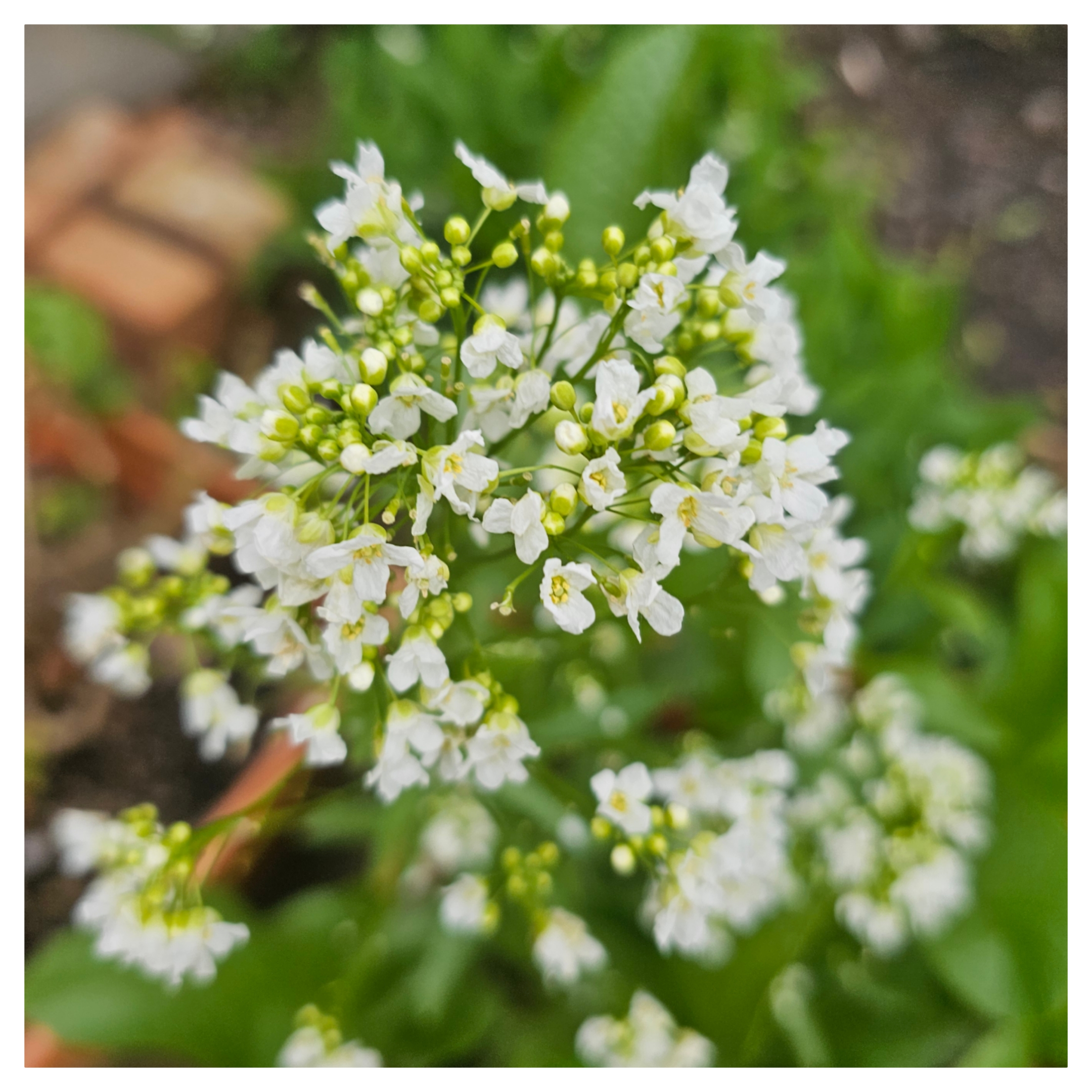
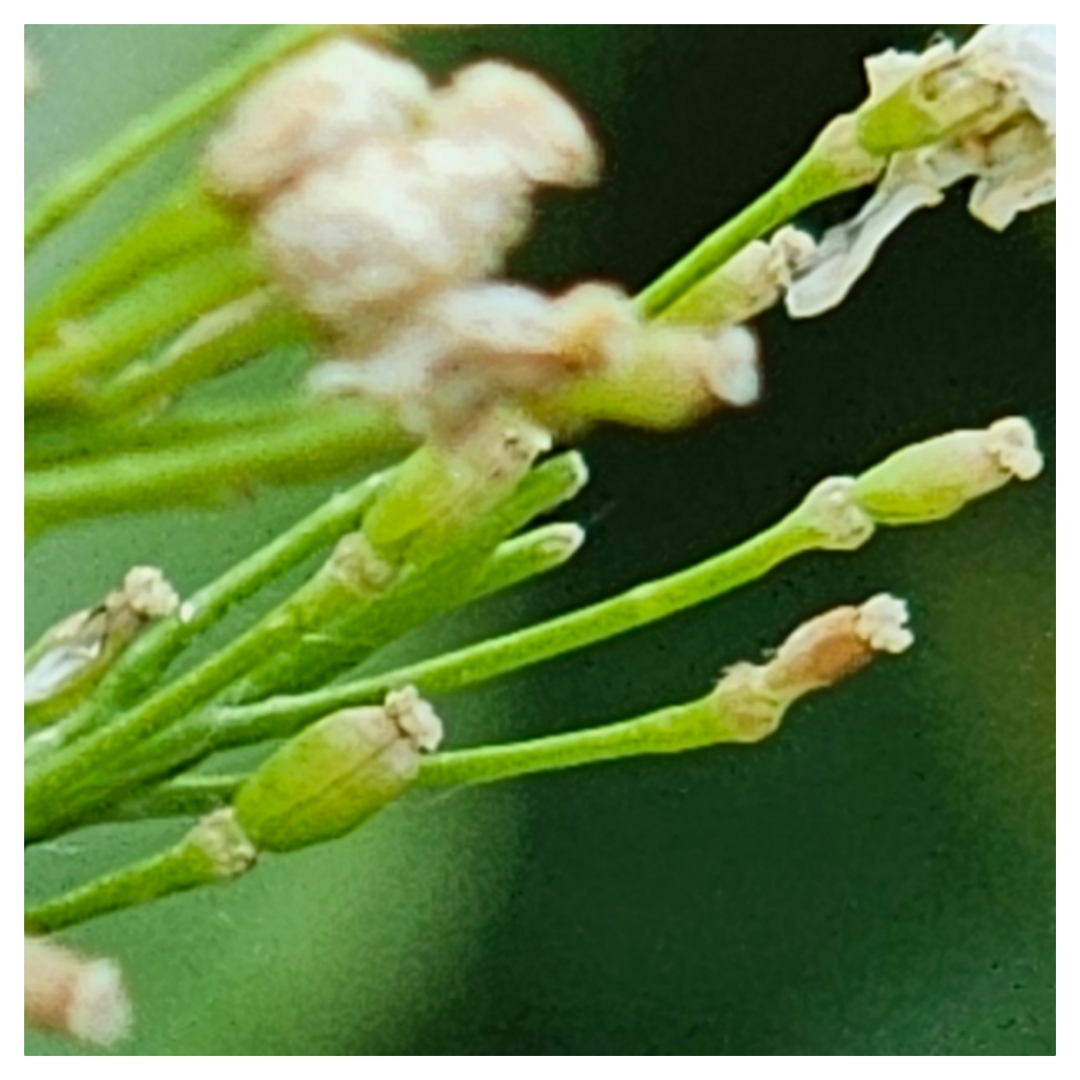
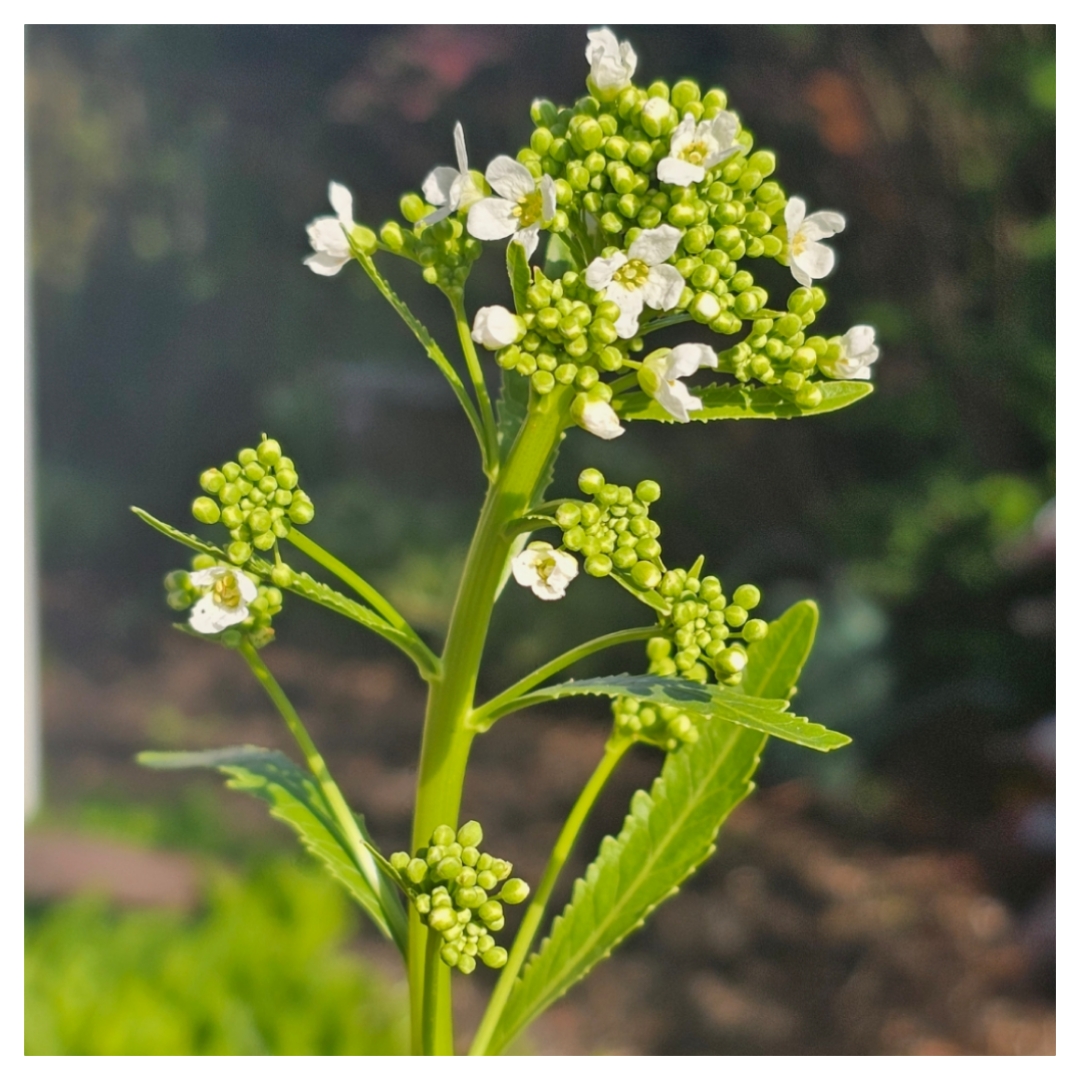
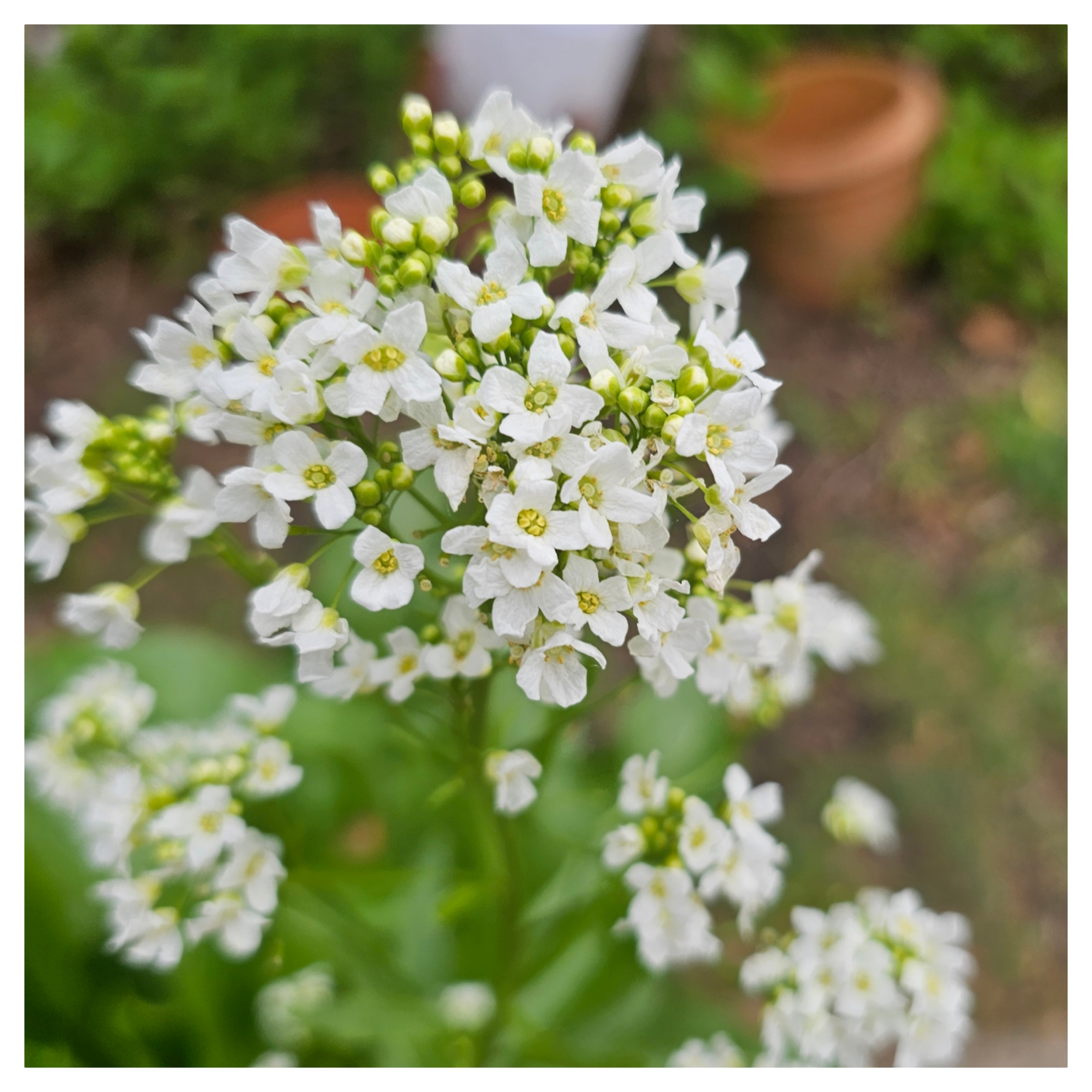
The beautiful, fragrant flowers of Armoracia rusticana, the horseradish plant, make for just one of the many excellent reasons to grow this extremely hardy perennial as a permanent resident in an ornamental garden.

Horeseradish Plant Nomenclature, Taxonomy, and History
Armoracia rusticana Nomenclature and Taxonomy: The One and Only Horseradish Plant
The horseradish plant, Armoracia rusticana, is a member of the plant family Brassicaceae, which also includes cabbage, mustard, wasabi, broccoli, and radish.¹³ In addition to rusticana, the genus Armoracia includes two other recognized species: macrocarpa and sisymbrioides.¹⁴⁻¹⁶ But rusticana is our baby today. It’s the star species of this show. It’s the one that’s packed with gastronomic zing, optic bling, and olfactory ka-ching.
Even though Armoracia rusticana is the one and only true horseradish plant, the species can, by any number of often conflicting accounts, be broken down into two main categories or types – the common horseradish (also widely called ‘Maliner Kren’ horseradish), and the ‘Bohemian’ horseradish. But starting with even this broad categorization, conflicting nomenclature abounds. For example, one source actually considers ‘Maliner Kren’ a ‘Bohemian’ type,¹⁷ while others simply consider ‘Maliner Kren’ another name for the common horseradish type.¹⁸ To make matters even more confusing, other (extremely reputable/reliable) sources consider another horseradish variety, ‘Western Big Top’, to be yet a third main Armoracia rusticana category.¹⁹,⁴² From here, the organization of horseradish cultivars and varieties becomes even more fuzzy. Descriptions and interpretations of appearance vary, and additional means of grouping/classification are all over the place.²⁰⁻²¹ Essentially, there are a bunch of different horseradish varieties/cultivars with a bunch of different takes on what they actually are, what they look like, and how and where to categorize them.
I’m ultimately chalking up this wide range of interpretations to the fact that, before the 1950s, the number of different horseradish cultivars was very limited due to the almost impossible task of growing (and ultimately crossing) these plants from seed. In those days, horseradish growers could only propagate new plants from the root cuttings of those cultivars they’d already been growing.²²,⁴⁵ But in the 1950s, new types of breeding/cross-breeding, including sophisticated and highly successful germination methods, were implemented, which resulted in a proliferation of new horseradish cultivars/varieties.²²,⁴⁵ I have more than a sneaking suspicion that this minor explosion in the number of horseradish cultivars/varieties, combined with the fact that each of these individual cultivars is heterozygous (and therefore will not seed and grow true to type),²²⁻²³ and exacerbated by the unreliability of human observation has resulted in the seeming arbitrary and inconsistent lumping of horseradish plants into loose categories by subjective interpretations of appearance (and to maybe an even greater degree, of the flavor of prepared root).
From the perspective of keeping a lid on the number and nomenclature of available horseradish cultivars, the fact that cross-breeding methods (including the above-referenced sophisticated germination processes) remain almost exclusively in the capable hands of responsible commercial growers/producers (predominantly in Collinsville, Illinois) and are used only in the development of new cultivars and NOT in general commercial propagation (root cuttings from existing cultivars are the only method used to accomplish this) works toward limiting the confusion arising from the proliferation of varying cultivar nomenclature/appearance interpretations.²²,⁴⁵
For right now, I think the best way to simplify this name game thing is by making a few main points about the categories/types/varieties/cultivars of horseradish available to Mr. or Ms. Consumer:
- Horseradish plants belonging to the common (or ‘Maliner Kren’) horseradish category can generally be considered to have broad, crinkled leaves, and very substantial roots of high culinary quality.²²
- ‘Bohemian’ category horseradish plants can generally be considered to have narrower, smooth leaves with less substantial roots, and are more resistant to disease.²²
- ‘Western Big Top’ (or just ‘Big Top’) horseradish plants can generally be considered to have broad, smooth leaves (though I’ve got my own reservations about the “smooth” part), enormous roots, and excellent disease resistance (particularly to the turnip mosaic 1 virus).²²
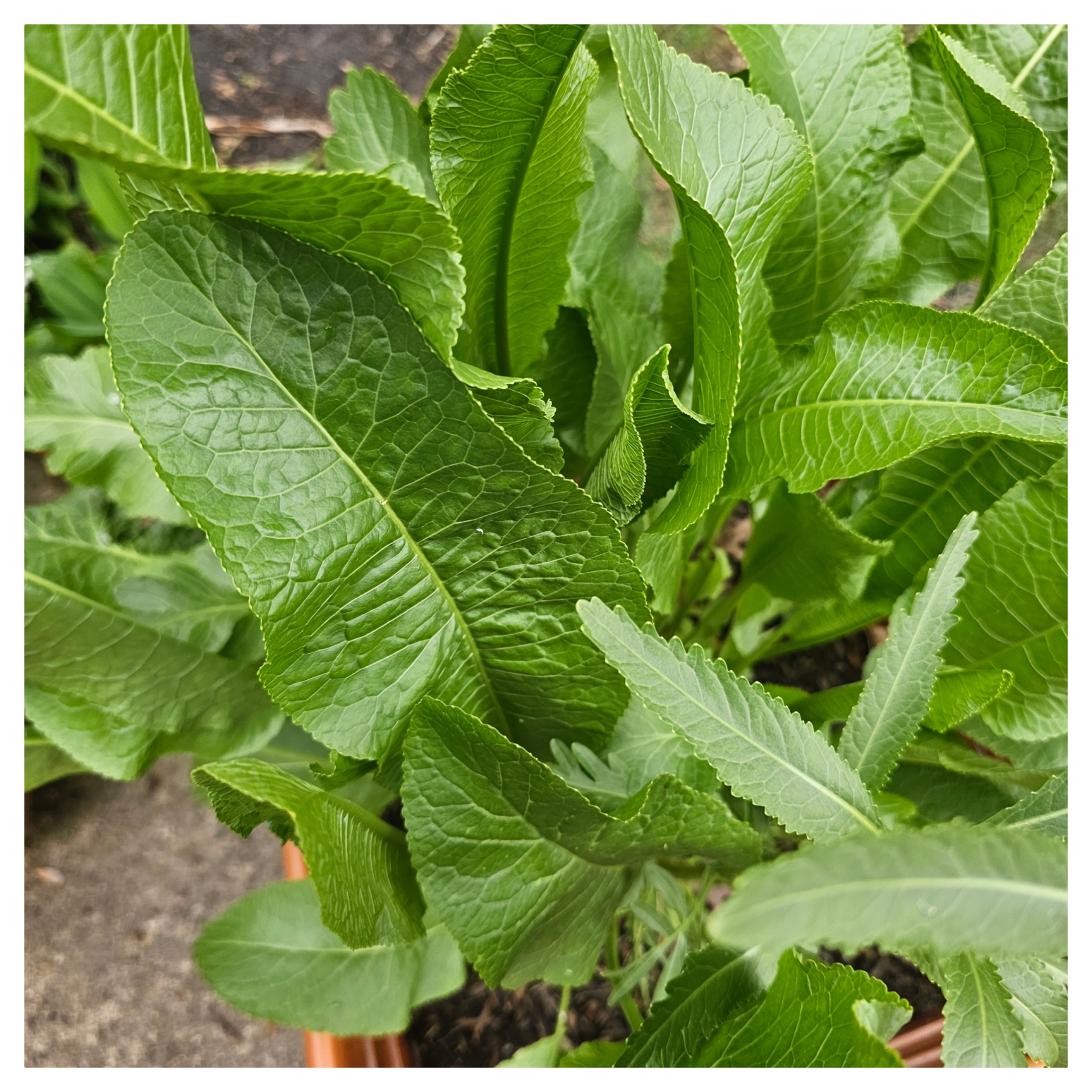
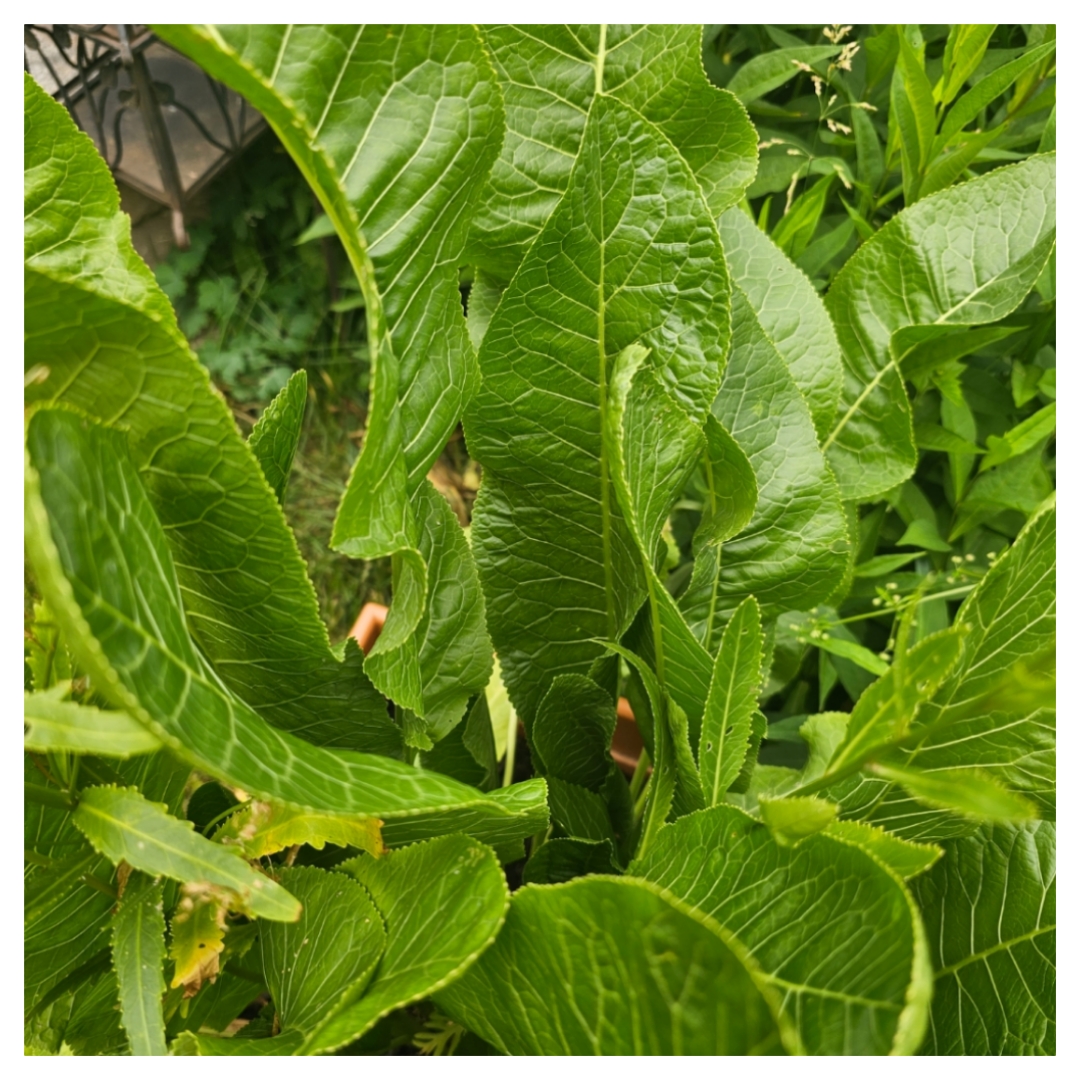
- The horseradish plants I grow are of the ‘Big Top’ variety, and, despite “smooth” leaf decriptions from various sources, many of the leaves of my ‘Big Tops’ are, in fact, substantially undulate (wavy) – almost bordering on crinkled territory. I guess it all depends on the definition of “crinkled.”
- Finally, always remember that there’s only one species of horseradish plant: rusticana. Any sort of horseradish you come across in your horticultural and/or culinary adventures is always simply going to be a variation on that single theme.
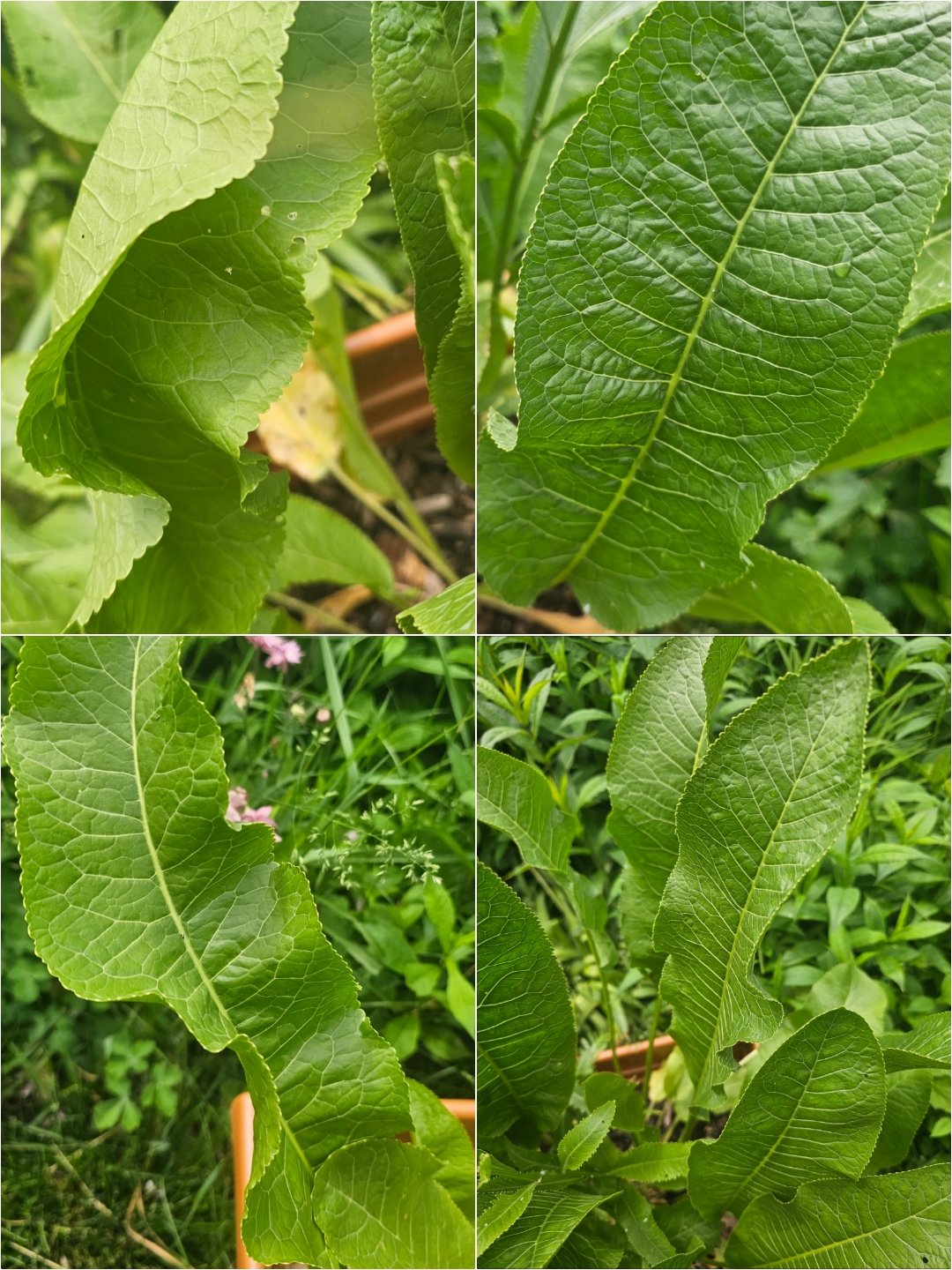
My own Big Top Horseradish plants, Armoracia rusticana ‘Big Top’. An entire circus tent of descriptions of this cultivar reference “smooth leaves.” Do these leaves look smooth to you? More like wavy-bordering-on-crinkled, I’m thinking. I guess it’s a matter of opinion. Current, popular horseradish categorization can be sort of a clown show.
Horseradish Plant History
The horseradish plant we know and love today has a rich and storied past, and, throughout history, has enjoyed a mutifaceted relationship with humans who’ve employed it as a medicine, partaken of it as a staple in religious ceremonies, and have downed it as a condiment and spice. It’s considered native to Southeastern Europe and Western Asia²⁴⁻²⁵, and although there are plenty of claims that civilizations such as Ancient Egypt had knowledge of it as early as 1,500 BC,²⁶ it’s likely that horseradish has been in actual cultivation for around 2,000 years, give or take a century or two.²⁷
In one of the earliest recorded references to horseradish as a cultivated plant, the Roman historian Cato the Elder includes mention of the horseradish plant in his treatise on agriculture, De agra cultura, c. 160 BC.²⁵, ²⁹⁻³¹ An image(s) of the plant appears in a painted mural (dated somewhere between the 2nd century BC and the 4th century AD) in the ancient Roman city of Ostia.³²⁻³³ Pedanius Dioscorides, widely considered “the father of pharmacognosy”, in another of the earliest recorded references to the horseradish plant, cites it as a medicinal treatment for back pain, c. 50 AD-70 AD.²⁷⁻²⁸
Poring over all of this info from Antiquity, I got the sense that the only thing people were doing with horseradish during those centuries was medicating themselves. This particular application, in fact, extended far beyond the period of Antiquity and has persisted through the Middle Ages, the Renaissance, the 17th, 18th, and 19th centuries, right up through today. Everyone from ancient Greek and Roman pharmacists and scholars, to Renaissance botanists, to North American Indigenous peoples, to modern medical practitioners and their patients, have been and/or still are using horseradish as a cure for what was/is ailing them.²⁵, ³⁴
But documentation exists suggesting that, from as early as the the Middle Ages, people were subjecting their taste organs to horseradish’s sensory wrath for reasons other than the medicinal. Starting somewhere between the 10th and 13th centuries, and continuing through present times, observers of the Jewish faith consumed horseradish as an ingredient of Maror, the bitter herbs element of the Passover Seder.³⁵ As Maror, horseradish was meant to represent the bitterness and harshness of the slavery endured by the Jewish people in Ancient Egypt.³⁶⁻³⁷
The oral, optical, and nasal anguish inspired by the insertion of horseradish into the human mouth ultimately became an epicurean form of masochism as our Armoracia rusticana traversed ingestion and application genres to find itself taking its rightful and most prominent place as a condiment. One early recorded confirmation of horseradish’s use as a spicy food add-on came in 1597²⁵ when English herbalist John Gerard,³⁸ in his The Herball, or Generall Historie of Plantes,³⁹ referenced horseradish specifically. Although this publication was written as an herbal (a book recording, documenting, and describing the medicinal qualities of plants), Gerard clearly notes that “[T]he Horse Radish stamped with a little vinegar put thereto, is commonly used among the Germans for sauce to eat fish with and such like meats as we do mustard.”⁴⁰ From that point in time, it didn’t take long for horseradish’s zesty gastronomic élan to spread westward to England, where, by 1640, the eyes and noses of peasants in rural areas were leaking copiously over its sensory impact.⁴¹ Ultimately, the English aristocracy would get its own snootful of horseradish by the late 1600s,⁴¹ and, by the 1700s, it reached the American colonies. Once commercial production of horseradish geared up in the U.S. in the 1850s,⁴¹ its nose clearing die was cast, and as far as humanity worldwide getting to know and love horseradish as something that spices up its schnitzel, salad, or scallops is concerned, the rest, as they say, is history.
From what I’ve laid on you to this point, it should be clear to you that horseradish continues to be used as a medicinal treatment and a sacred element of solemn religious ceremonies to this day. Still, its most popular and pervasive use here in modern times is as an eye-nose-and-mouth-stinging condiment. Lots of people grow it and process it for that purpose, and lots of people follow up by eating it. And the main point of this article certainly does concern growing horseradish, but it concerns growing horseradish not as a food source but as a pretty plant to keep in your garden for years and years as an awesome ornamental perennial. So screw the lid back on the Heinz jar, get your hands off your wienerschnitzel and shove them into a pair of work gloves, then get your ass outside and grow yourself some horseradish as an eye-pleaser, NOT a mouth-searing, brain-burning, snot-inducing tearjerker. Here we go…

Armoracia rusticana Nuts and Bolts: It's Got Pretty Leaves and Flowers (So Please Don't Eat the Horseradish!)
The Basics
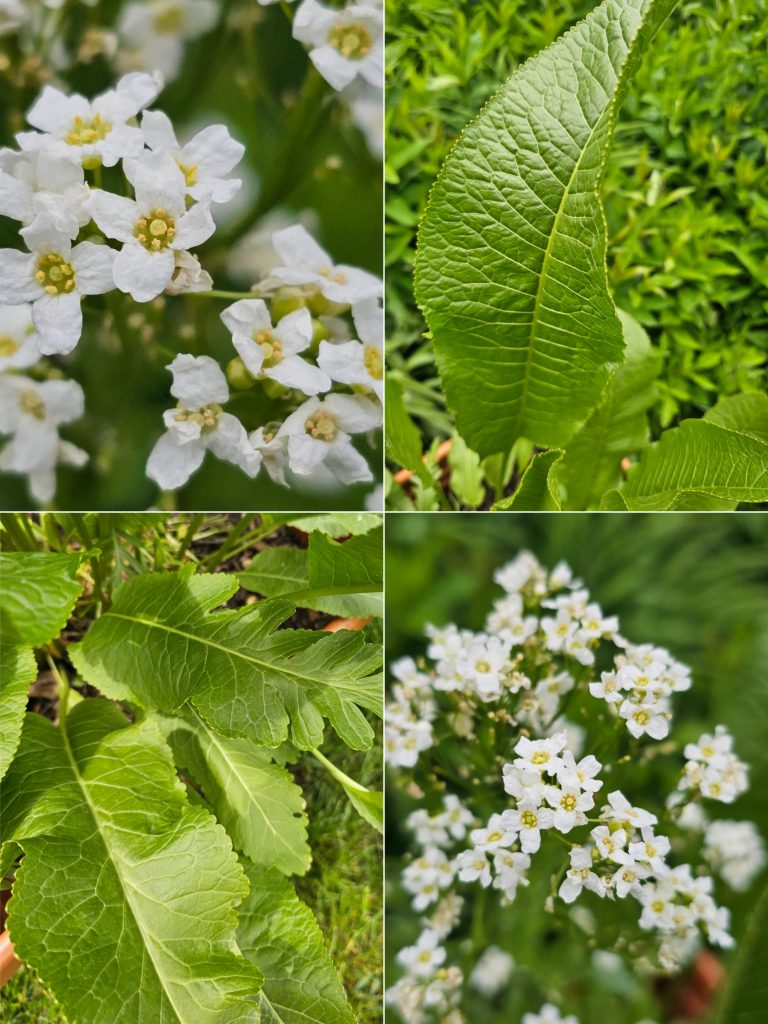
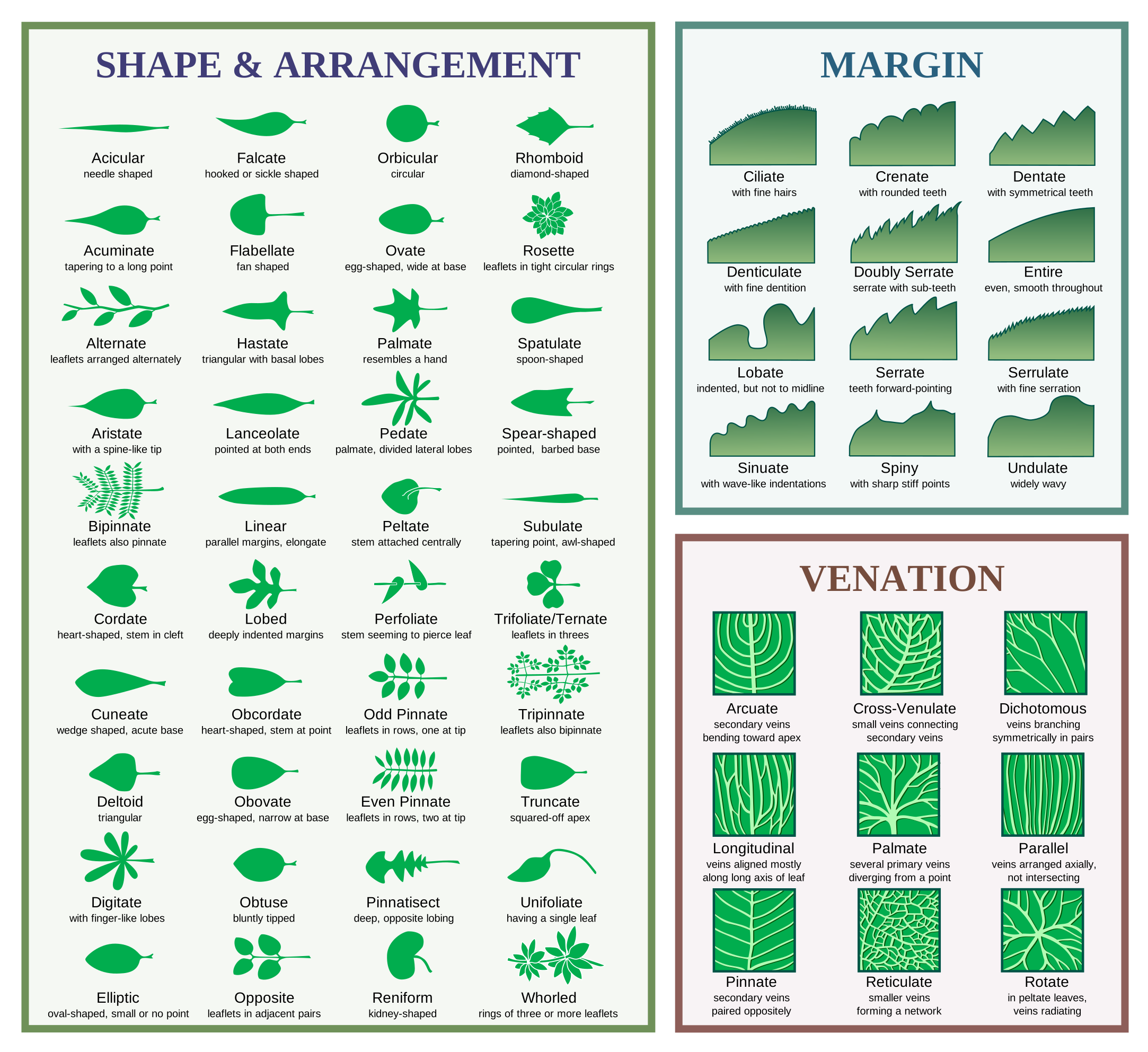
Common name – horseradish, (‘Big Top’ horseradish, in the case of what I grow). Botanical name – Armoracia rusticana. Plant family – Brassicaceae; includes such other genera as Brassica (cabbage, broccoli, and mustard), Eutrema (wasabi), and Raphanus (radish). Height – 2.5′-3′ (taller with flower stalks and stems). Spread – 2.5’– 3′. Light – full sun. Bloom color – white; very fragrant; attractive to pollinators. Bloom size – less than 1/2″, 4-petaled with 6 stamens, growing in clusters on compound racemes. Bloom time – spring (Later April through mid May in Hardiness Zone 5B/6A with small, oblong seed pods forming in late May). Foliage – leaves grow in a rosette and can be well over two feet in length; leaves are smooth, undulate, or crinkled (depending on the cultivar/variety); rich green or variegaed (per the cultivar/variety); ovate (rosette leaves) and lanceolate/linear (flower stalk leaves) in form with serrated/serrulate margins, but individual plants can demonstrate varied leaf morphology and additionally feature individual leaves (in the case of both the rosette and flower stalk foliage) that are deeply lobed (so much so that they can appear to be divided/pinnately compound, though they’re not). There’s much more on this different-leaf-shapes-on-the-same-plant phenomenon later in this article. Hardiness – Zones 3–9 (but can even tolerate Zone 2 temps). Root system – fleshy with a deep taproot and extensive rootlets (horseradish plants spread aggressively via rhizomes); even after harvesting, portions of root left in the ground can form new plants. Soil – medium, moist, well-drained, slightly acidic to slightly alkaline; humus-rich soils or soils enriched with organic fertilizers encourage foliar and root growth. Growth rate – fast. Pollinators – bees and butterflies. Toxicity – non-toxic to people and pets (but feeding it to Bowser or Mittens isn’t recommended). Pest resistance – Not bothered by mammalian pests like deer, voles, or chipmunks; susceptible to leaf damage by grazing cabbage looper caterpillars (thanks to my wife for the ID on these guys); some varieties can be somewhat susceptible to the turnip mosaic virus; like any plant, Armoracia rusticana is susceptible to root and stem rot if left saturated in over-watered, poorly-drained soil. Longevity – years and years – they’re considered long-lived perennials and can persist for decades (centuries?). Propagation – root division/root cuttings; seed propagation is very difficult, unless you really know what you’re doing (for me, it’s impossible).

Notes from the Field: Please Don't Eat the Horseradish! My Experiences Growing Armoracia rusticana as an Ornamental Garden Perennial in Hardiness Zone 5B/6A
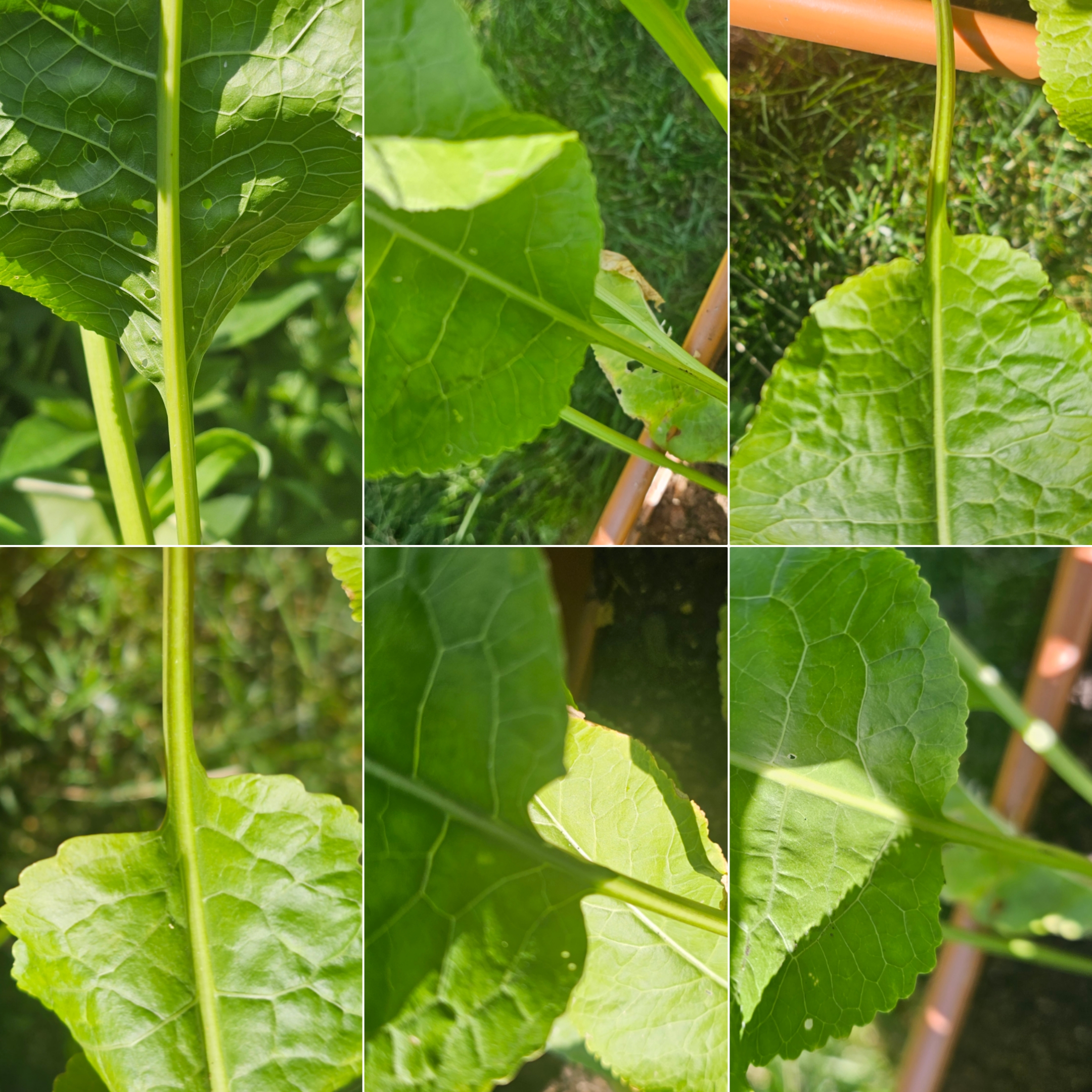
Foliage. My Big Top horseradish plants (Armoracia rusticana ‘Big Top’) were ordered as bare roots from an excellent, family-owned organic seed company, which you’ll read about shortly (spoiler alert: this company is an RGG affiliate partner, and its banners are featured throughout this article). The Big Top bare roots were planted in the early spring, and within 2 weeks had sprouted. They put on amazing growth in the first year, displaying beautiful, substantial foliage that proved to be resilient and persistent. Despite widely accepted descriptions of the Big Top’s individual leaves being smooth, my specimens displayed leaves that were undulate (wavy) and, in some cases, could have almost been considered mildly crinkled. It bears mentioning one particular element of leaf morphology that’s a key factor leading to the division of Armoracia rusticana into three basic categories/types (as referenced in Subsection 2.1 above): the shape of each type of plant’s leaves at their bases (the place where they join their petioles). My Big Top horseradish plants’ leaves, in keeping with this categorization standard, are tapered in shape at their bases.⁴²
In any case, the foliage of the Big Top plant is gorgeous. It’s rich, green, dramatically enormous, and, in my garden, is undeniably an attention-grabber. I’m thrilled with the look of those Big Top solid green, wavy leaves, and lots of people that have visited my garden over the years seem to be too. However, for those who require an even more dramatic visual punch from their horseradish foliage, there is available an insanely beautiful variety with variegated leaves. Armoracia rusticana ‘Variegata’ adds bright splotches of yellow-white to the deep green of its foliage. It’s a striking plant to grow as an ornamental.
Grow them in pots. I do. If you’re following this article’s general recommendation and planning to grow your horseradish plants as ornamental perennials, growing them in attractive (and large and deep) flower pots is a great idea. The aesthetics of potted horseradish culture are remarkable. There’s nothing quite as visually stunning as that big leafy beauty stretched to its widest and highest, alone in its own container, unencumbered and unencroached upon by others of its kind.
But there’s another, more practical reason for growing your horseradish plants in containers: keeping them under control. There are three main reasons that a pot bound Armoracia rusticana is a well-behaved Armoracia rusticana.
- Because a horseradish plant’s root system is so effective at regeneration (which is why horseradish roots lend themselves so well to propagation by division), you can rest assured that even a tiny root fragment, if detached from its main tap root, will generate a brand new plant. Keeping a horseradish plant in a pot keeps unwanted stragglers from cropping up and establishing themselves in strange spots.
- The horseradish plant’s rhizomatous growth habit is very aggressive. If planted in the ground, one horseradish plant becomes many in a short period of time. A patch of horseradish plants can easily choke out other plants within an ever-widening perimeter. Growing one horseradish plant in a pot should, for the most part, ensure that it remains only one horseradish plant, since the boundaries of the pot’s circumference will limit the generation of rhizomes and/or their viability. That being said, one of my own Big Tops, growing alone in its own pot, this year (and for the very first time since I planted it) has rhizomatously generated a new plant. This fact should give you a pretty good idea of how prodigiously these plants spread.
- If a horseradish plant remains in the ground for more than a year or two, its tap root can get very, very long. It’s not uncommon for established plants to have tap roots that reach down more than 10 feet into the ground.⁴⁴ As you can imagine, it’d be a real bitch to remove one of these. The length of the root, coupled with its regenerative abilities ensures that there’ll be a horseradish plant in that particular spot forever. Keep your own horseradish plants in pots, like I do with mine, and their insane tap root length becomes a moot point.
A note about overwintering potted horseradish plants outdoors: Because these plants are so incredibly cold hardy (potentially down to Zone 2), my own horseradish plants remain in their pots outdoors all winter long in Zone 5B/6A without the benefit of any additional winterizing steps. In colder zones (eg. 2, 3, or 4), however, a potted Armoracia rusticana, like any other potted perennial overwintered outdoors, will need some additional protection. Please read “Winterizing Exposed Potted Perennials” and “How to Overwinter Potted Perennials Outdoors”, my two articles, published here in The RGG in 2024 and 2021, respectively, for some solid advice on helping any potted perennial make it through the winter outdoors.
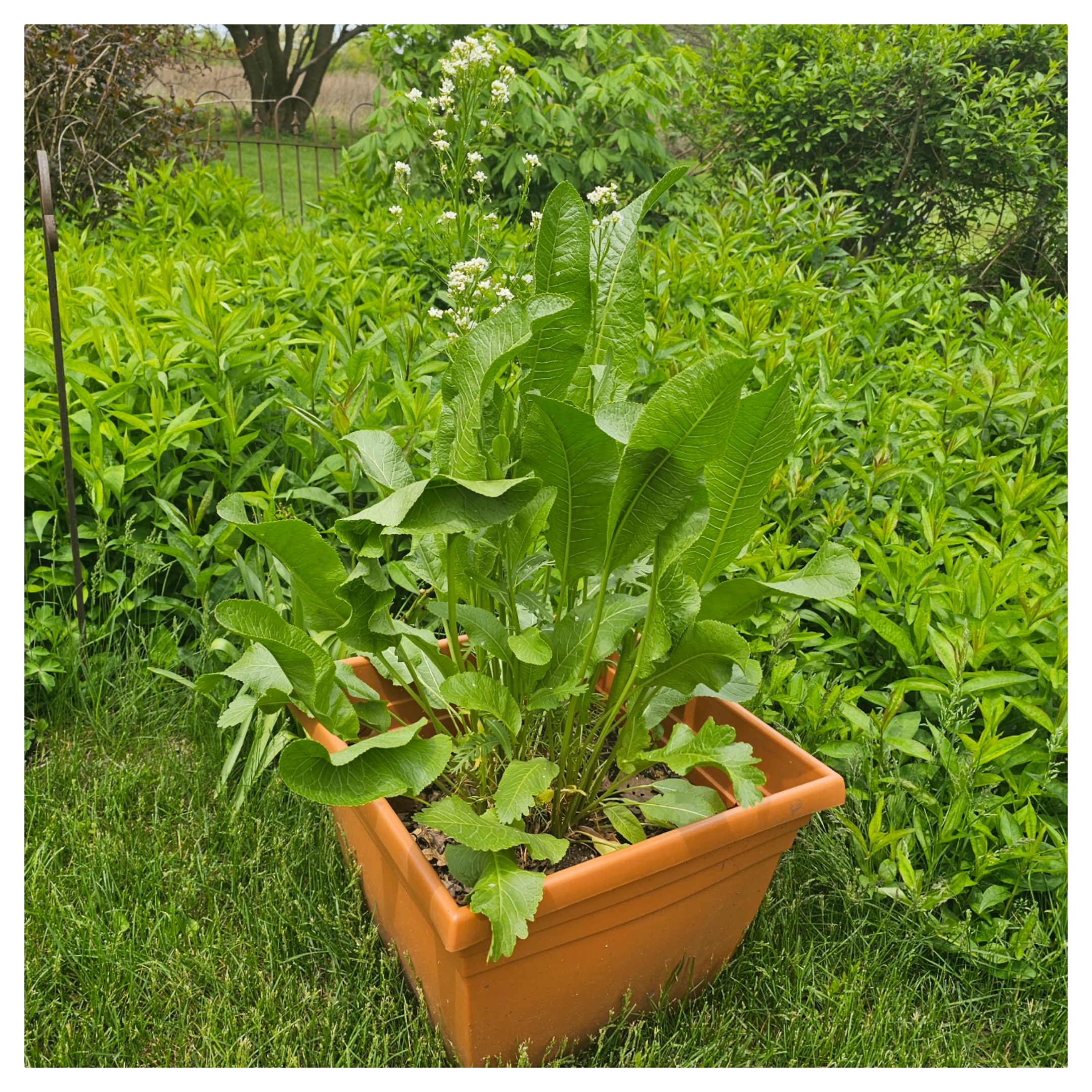
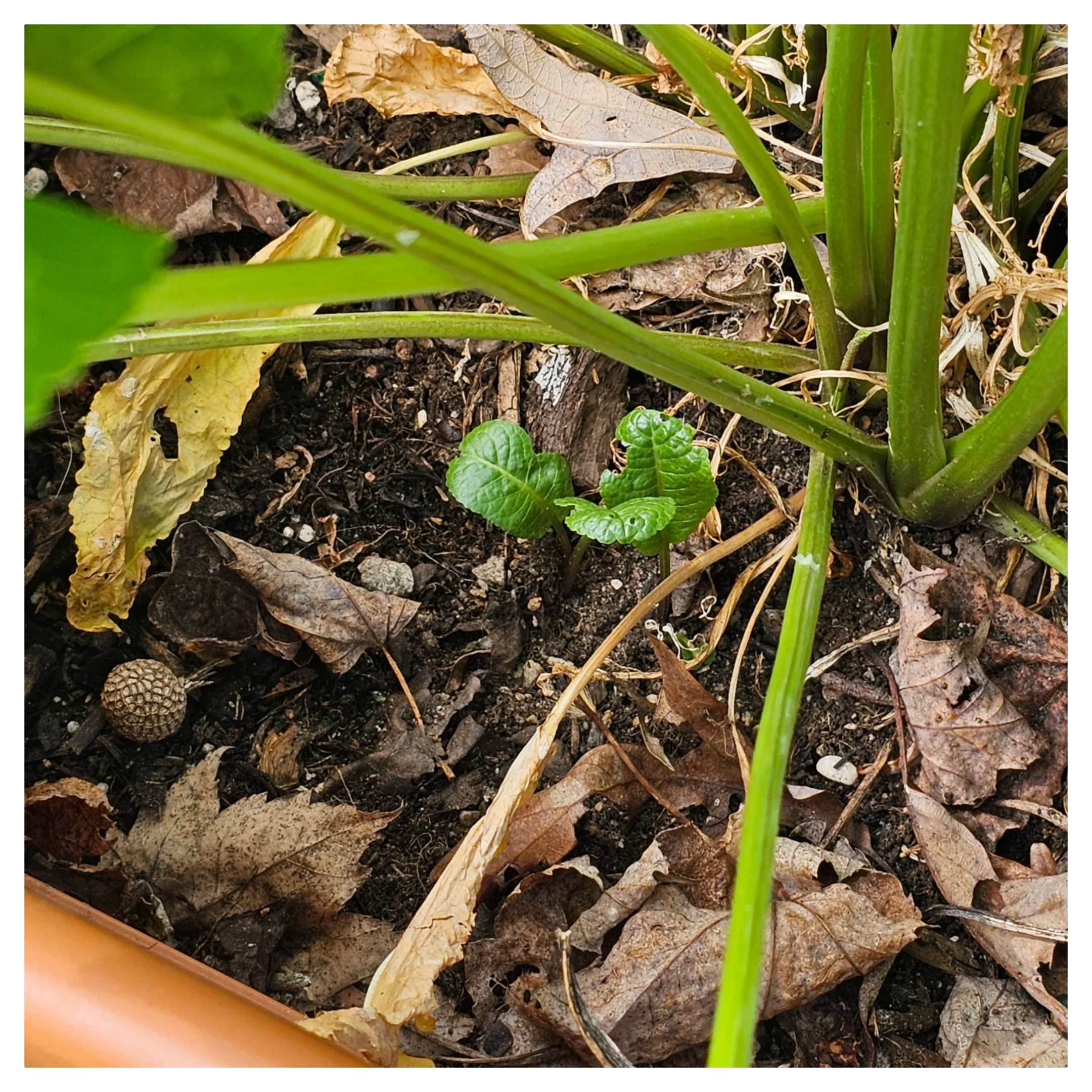
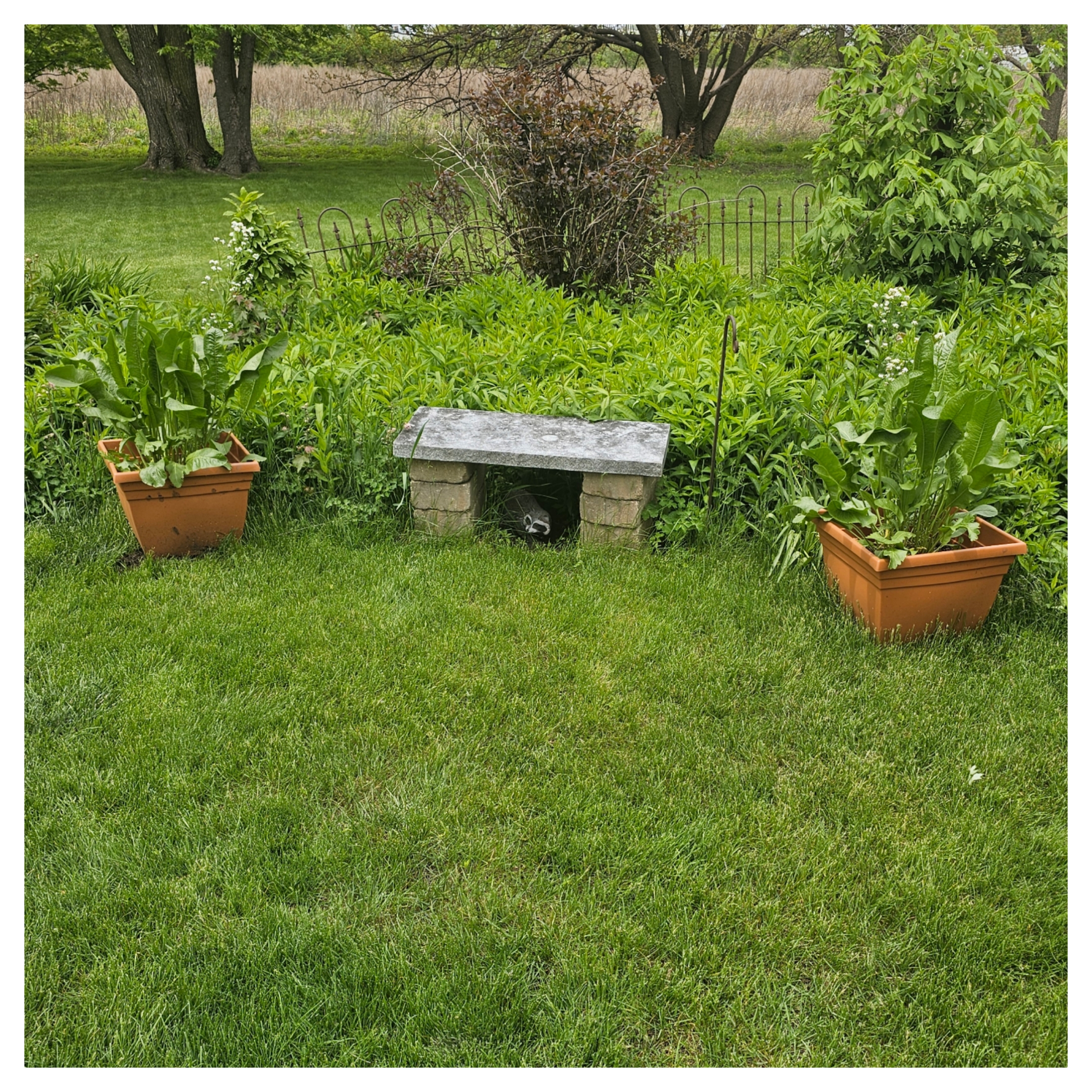
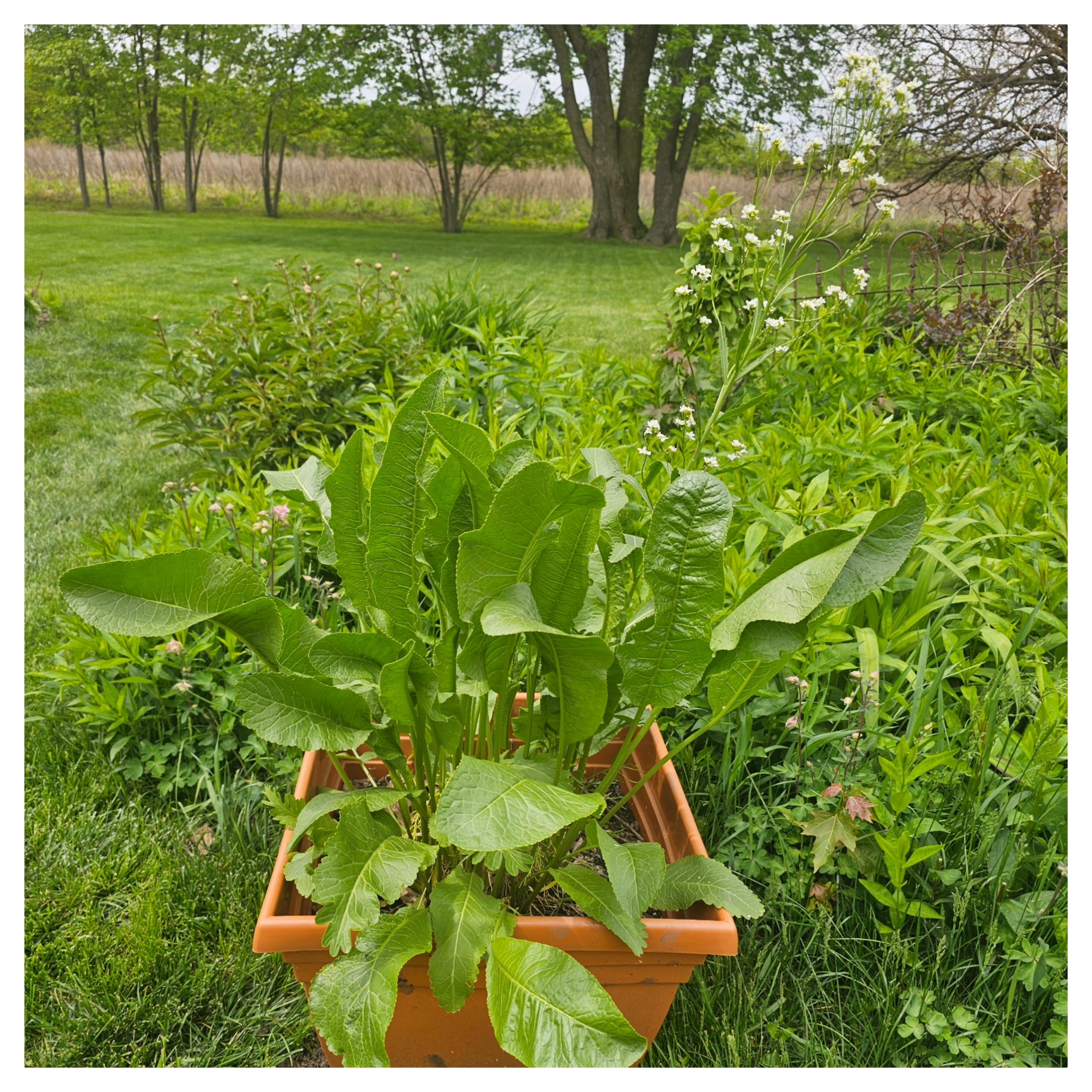
Armoracia rusticana not only looks cool growing in pots, it’s also really easy to move around. A potted horseradish plant makes for the perfect outdoor furniture accent piece!
Beautiful, fragrant flowers. Probably the most underrated feature of the Armoracia rusticana plant is its flowering habit. Home edible garden growing types who grow it as a personal food crop don’t care about the horseradish plant’s flowers (unless they’re attempting the mostly futile task of propagating it from seed), and retail consumers who grow the plant as an ornamental perennial in their gardens mostly do so for the plant’s striking foliage and form (hence the development of the bicolored leaves of the variegated horseradish plant, Armoracia rusticana ‘Variegata’). But me, I’m different. Although I do love my horseradish plants’ groovy foliage, I really love their beautiful, fragrant little flowers.
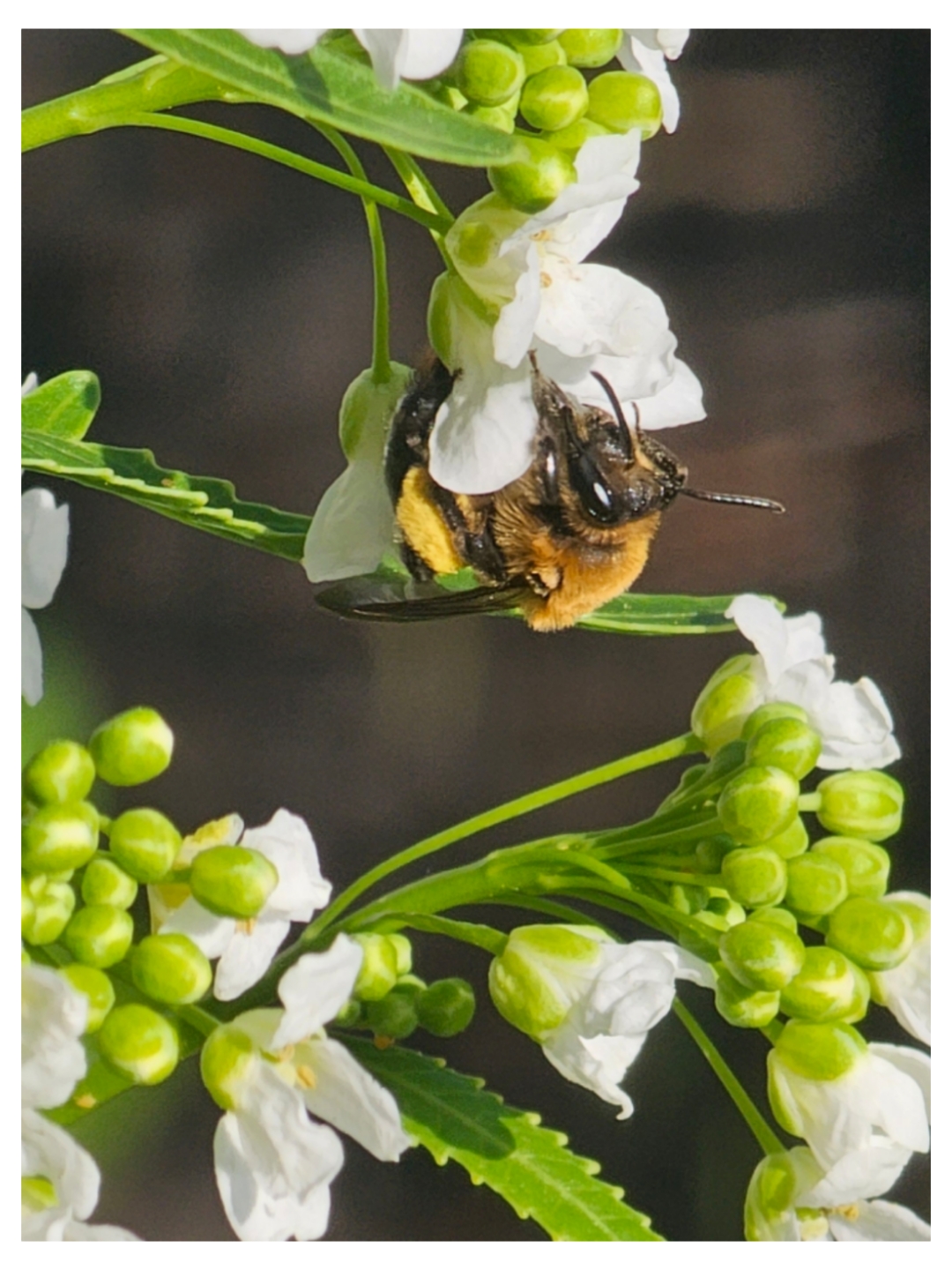
These flowers themselves are tiny – less than 1/2″ across – and they’ve got 6 stamens, 1 pistil, 4 petals, and 4 sepals.⁴⁴ Even though the individual flowers are small, they form in substantial foamy white masses on panicles (compound racemes). When these beautiful white clusters rise above the plant’s rich, green foliage on their tall stalks, the effect is visually arresting. But as beautiful as these flowers – and the contrast their bright white petals make with the plant’s foliage – are, it’s their fragrance that really drives me wild. And I’m not alone. Their sweet scent is super-appealing to butterflies (Painted Ladies and Cabbage Whites are all over them) and bees.
Buds form on the racemes in late March/early April (Zone 5B/6A), and by the second or third week of April they begin to open. Usually by the third week in May, the flower petals drop and little oblong seed pods begin to develop.
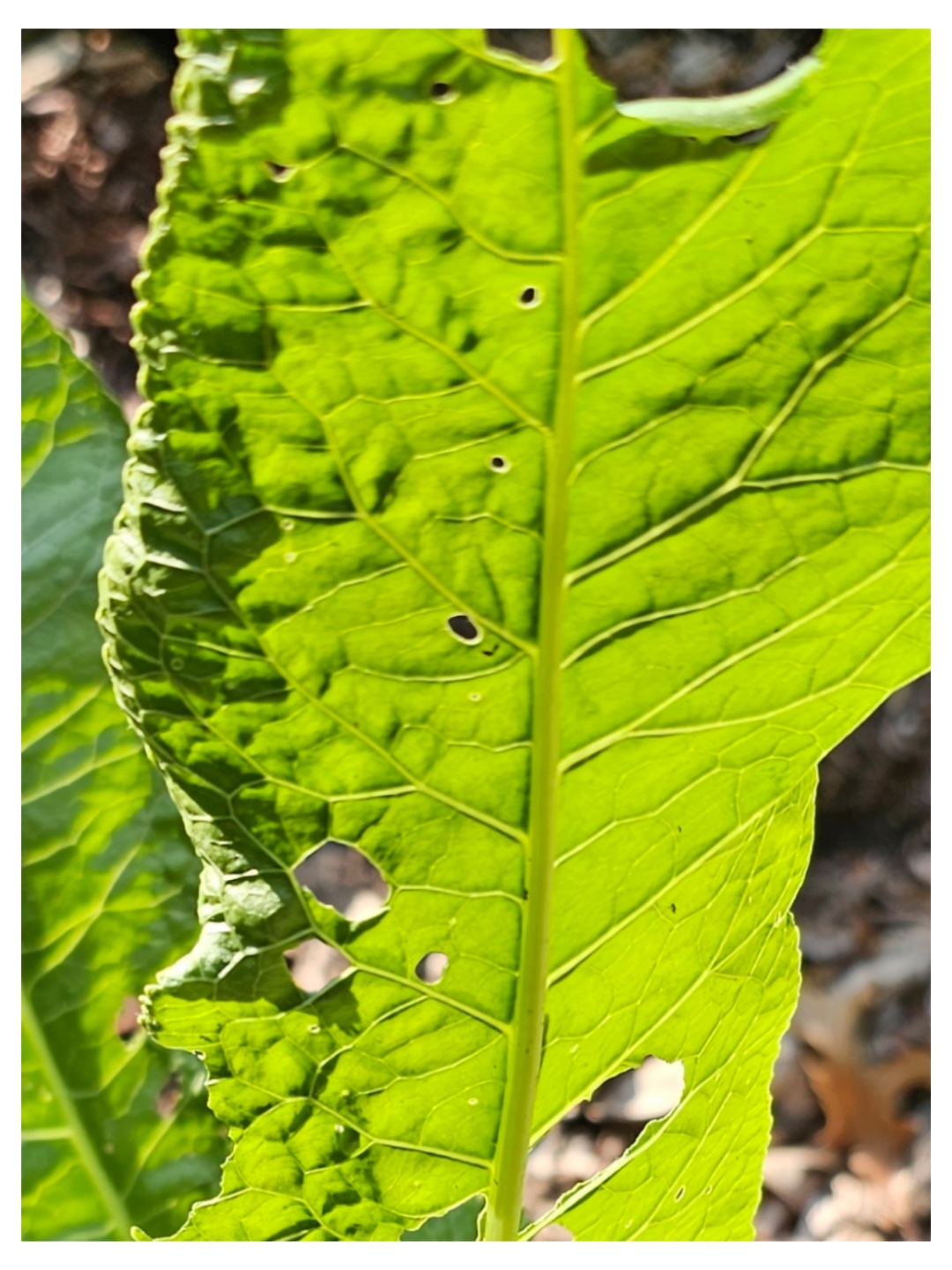
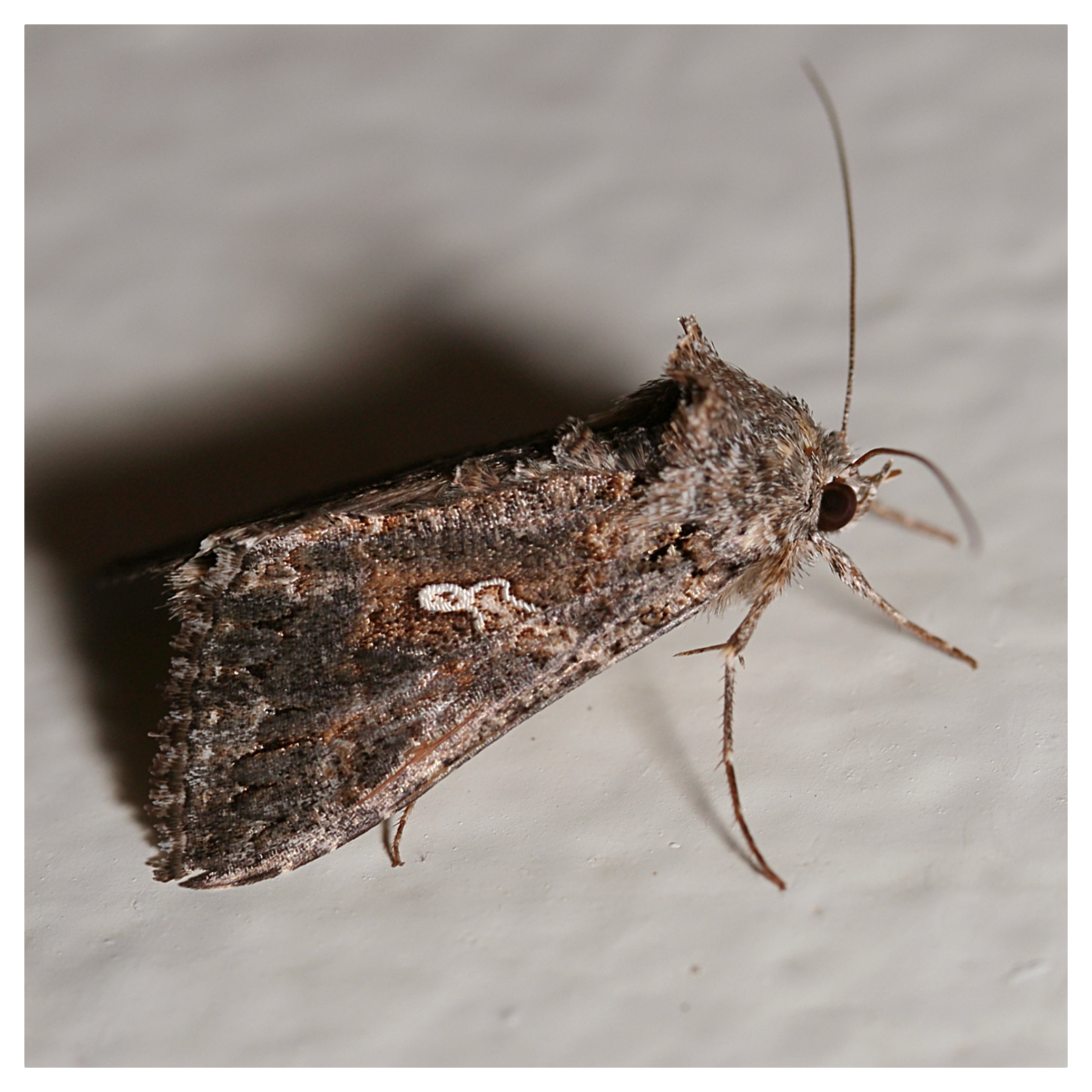
Pests. In The RGG Michiana Shores garden, horseradish plants are regularly assaulted by the larvae of Cabbage Looper moths (Trichoplusia ni). These little green, essentially hairless caterpillars* emerge from tiny whitish eggs that the female moth deposits on the undersides of leaves. I’ve also regularly see aerial assaults on my horseradish plant leaves by Cabbage Looper caterpillars: these little green marauders literally lower themselves onto the leaves of my horseradish plants from the branches of trees by thin “ropes” of silk. It doesn’t matter how they get there because, whether they hatch right there on them or drop in by air, they make a major mess of horseradish plant leaves by eating everything green between each leaf’s veins and on either side of its midrib. When Cabbage Looper caterpillars are finished with a leaf, what’s left is a skeletonized version of its former self. These assaults have never even remotely proven fatal to my horseradish plants. The results are just unsightly, and the plant ultimately generates new foliage to compensate for what’s been damaged.
*Note: Special thanks go to my wife Ann for the initial identification of these little critters.
Although Armoracia rusticana, as a species, can evidently be susceptible to turnip mosaic virus, my own specimens have never been infected with it.
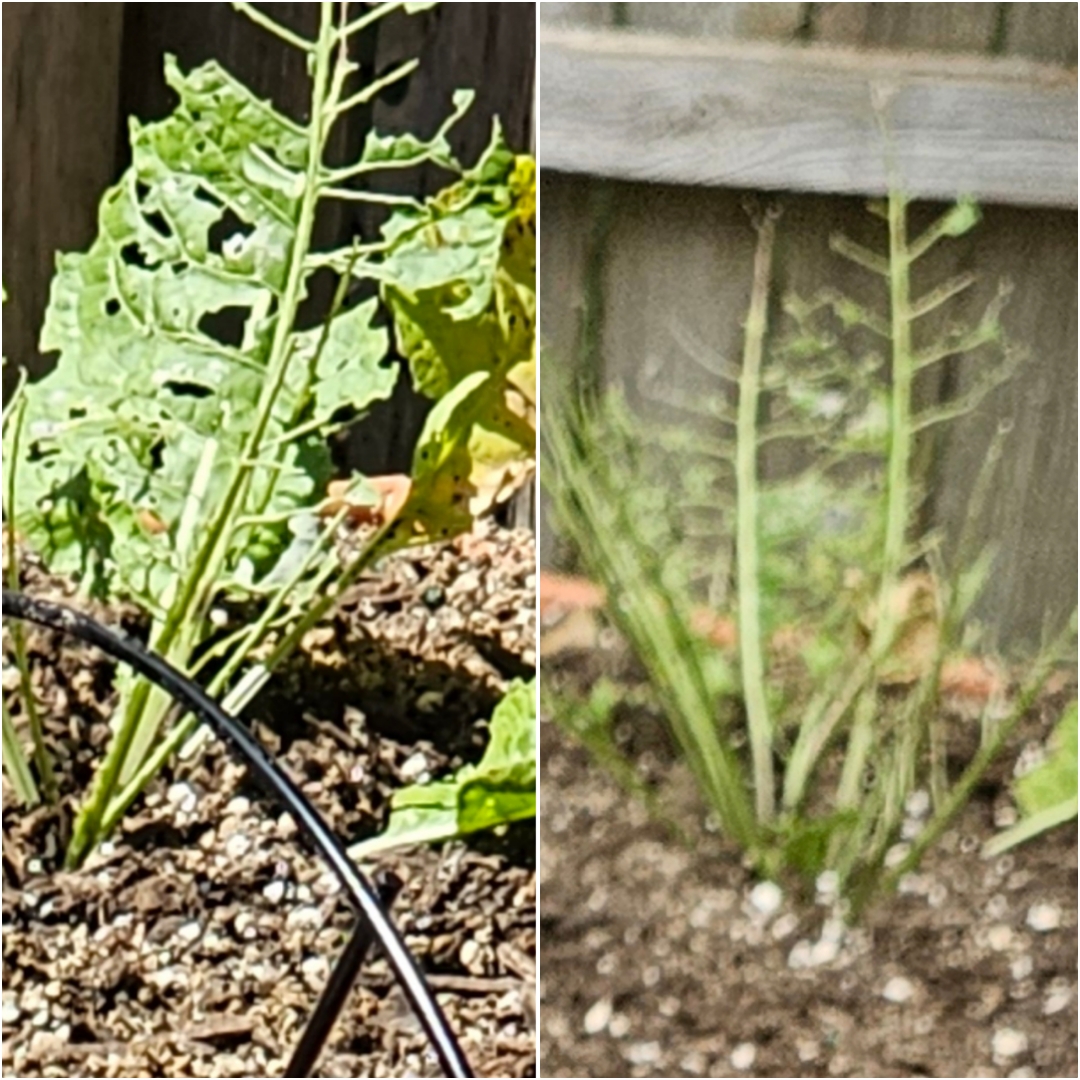
Skeletonized horseradish leaves are the handiwork of the larvae of the Cabbage Looper moth (Trichoplusia ni). The results of such assaults by these little green caterpillars are unsightly, but have never proven fatal to my plants.
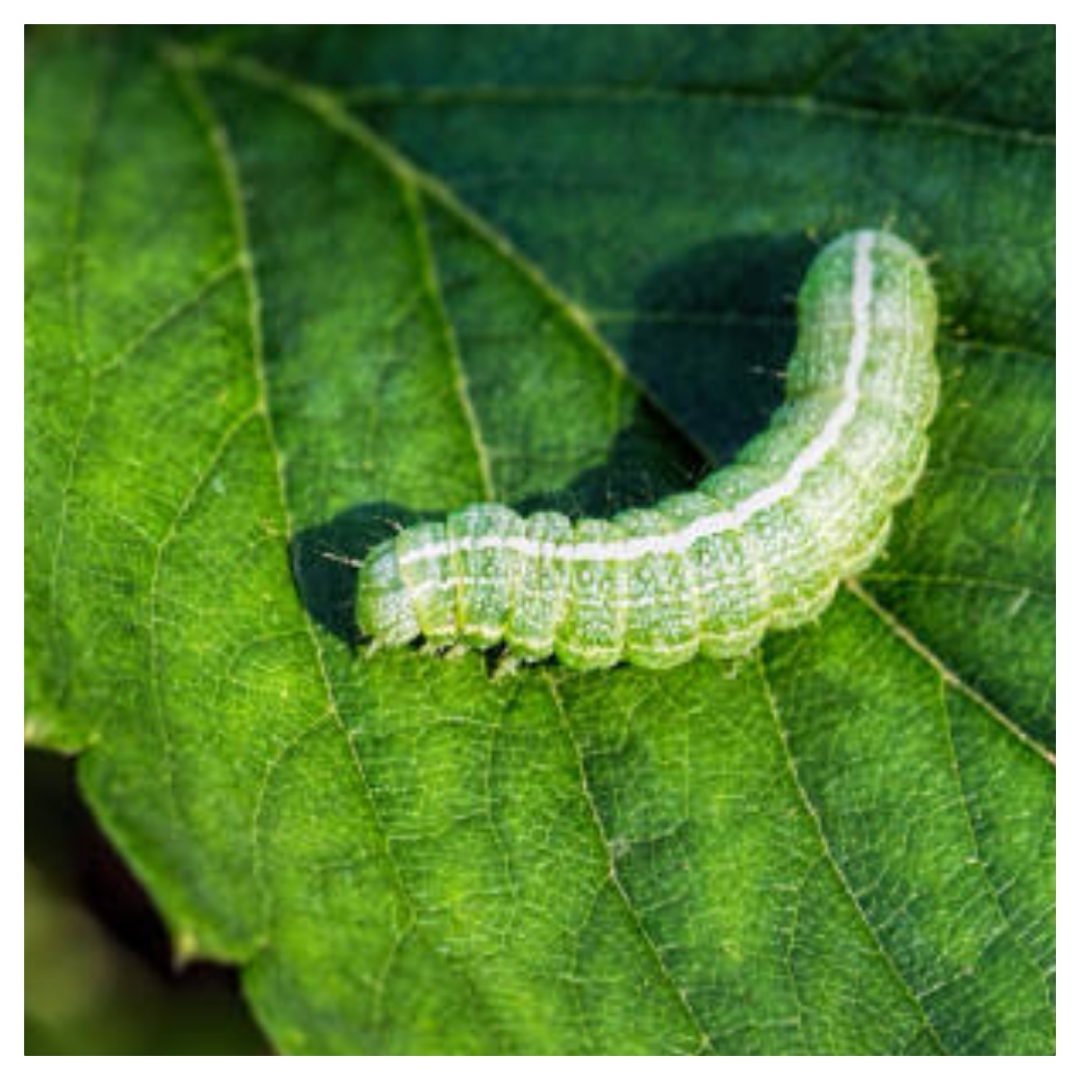
Cabbage Looper caterpillars (Trichoplusia ni) hatch from eggs laid on the undersides of leaves and make themselves right at home. They also drop from surrounding trees on fine, nearly invisible silk threads and unerringly land on my horseradish plant’s leaves. Their ability to zero in on their targets is uncanny. Photo credit: Evgeny Tkachev.
Suggestions for Planting Horseradish
- Plant them in early spring. If you’re a first time horseradish grower, it’s likely that you’ll be obtaining your horseradish plants as bare root cuttings from a reputable online or bricks-and-mortar nursery/grower (mine came from an excellent RGG affiliate partner, about which you’ll read a bit later in this article), which means you’ll have them at the correct planting time for your Hardiness Zone. In Zone 5B/6A, that time is early spring. But generally, once the soil becomes workable after winter, the time is right to plant bare root horseradish plants. Though I do know of other gardeners who’ve had success planting their bare root cuttings in late fall (while the soil remained workable), I’ve never done it and therefore can’t recommend it.
- Grow them in pots to keep them under control. If you don’t want them to spread like an infectious disease, or permanently establish themselves in indomitable, ever-expanding colonies, plant your bare root cutting horseradish plants in pots. As I wrote above, their rhizomes are aggressive and their roots run deep when they’re growing in the ground. Remember, even a small portion of its root can regenerate as a whole new plant. Of special note is the fact that the end result you’re looking for from your horseradish plants will dictate the size and the shape of the pots you buy for them. If you’re growing them for harvest, you’ll want a moderately deeper, substantially wider container than one you’d use to grow your horseradish plants as ornamental perennials. You’ll see why next.
- Planting orientation. Orientation of the bare root cutting is a critical factor in its planting because, like pot size, it’s largely determined by what you ultimately want out of your plant. First off, regardless of the fate you’ve got in store for your horseradish plants, when you stick your bare root cuttings in the ground, you need to know which end goes up and which end goes down. If you got them from a reputable nursery or grower, you’ll be able to tell their tops from their bottoms by looking at the way they’ve been cut: each top is cut even (straight across) and each bottom is cut at a 45° angle. They’re cut this way for no other reason than to help you plant them the right way. Secondly, with respect to your horseradish plants’ ultimate fate, the angling of the bare root cutting when it’s planted is critical. Setting the root at a 45° angle in the soil encourages the prolific growth of side roots.⁴⁶ Since these new roots aren’t just the bare root cuttings of tomorrow but are ALSO the bare root cuttings that end up in the horseradish sauce of tomorrow, if you’re growing your plants with an eye on eating their roots, the 45° angle route is the one to take. And more side roots mean bigger root systems, so your 45° angled, destined-to-be-consumed horseradish plants need a wide, fairly deep pot. (If they’re planted in a totally horizontal position, more leaf node development, and ultimately more rhizome development, will be stimulated along the length of the cutting and you’ll end up with just as much aerial growth – i.e. leaves, stems, and flowers – as you do root growth.)⁴⁷ Since I grow my horseradish plants as ornamental perennials, I position the bare root cuttings vertically in the soil. This encourages both robust tap root development (which doesn’t at all become a future removal issue since I plant mine in containers) and, more importantly, robust aerial structure development. Since the focus here for me is lush foliage rather than more edible root growth, the pots for my ornamentally-grown horseradish plants don’t need to be as enormous as those housing plants grown for consumption.
- Planting depth. The tops of the root cuttings should be 2″-3″ below the surface of the soil.
- Soil. Plant your horseradish plant bare root cuttings in slightly acidic, neutral, or slightly alkaline soil that is humus-rich, or augmented with a good granular organic fertilizer. With the exception of one time, a few years ago, when I tossed a couple of handfuls of dog crap into their soil (it worked out fine, and yes, I was wearing gloves), I exclusively amend the soil of my horseradish plants with an excellent granular organic fertilizer, which you’ll read about later in the Product Recommendations section of this article. Since horseradish plants like to be well-watered, it’s critical that the soil is well-draining.
- Water. I just told you. Horseradish plants like to be well-watered. This is particularly important when they’re first planted as bare root cuttings. It’s even more important when they’re growing in pots. Because they grow best in full sun, they can bake in the heat from a summer day. When their leaves begin to droop and wilt in these conditions, it’s time to water them. Heavily. As a rule, it’s always best to hydrate them frequently, but make sure that the water readily drains from their soil. You’ll kill them if you let them stew in soggy mud.
- Plant in a full-sun location. These plants are healthiest when they’re growing in full sun, where their foliage becomes the most robust and richly colored, and their flowering is the most profuse.
- Companion planting. Grow them in pots and you can stick them anywhere in your garden next to and/or among any bedded perennials. Plant them in the ground and watch them overrun and choke out anything growing nearby.
Horseradish Plant Continuing Care
- Pruning and deadheading. Cut off yellowing or dead foliage. You can cut back the flower stalks once all bloom petals have dropped off to prevent seed development. Doing so will encourage current season root development and might result in more robust foliage growth and flowering the following year. I leave plants’ flower stalks and seed pods in place because birds devour the seed pods almost immediately after the flower petals have dropped, so there’s no danger of compromising the growth of the plant’s other structures: no seed pods mean no seed development, so energy is allocated toward the development of its roots and next year’s foliage and flowers. Once the birds are finished eating all of the seed pods, I cut the flower stalks down. Cut all the rest of the dead stuff down to the soil level in late fall.
- Fertilizing. Since Armoracia rusticana likes it soil organic material-laden, it’s a good idea to amend the soil you grow yours in if it doesn’t meet this requirement. You can do this in a few ways, and at least one time during the growing season. If you own a dog, throw some of his or her shit into the mix. It worked for my horseradish plants the one time I tried it, and it’ll work for yours too. Mix some compost and/or manure in the soil. As good as or better than dog shit. Use a granular organic fertilizer. It’s convenient, it works great, and it’s way less gross than the first two methods. I’m recommending an excellent one a bit later right here in this article.
- Pest abatement. Here in The RGG garden, the horseradish plants take issue only with Cabbage Looper caterpillars. And I deal with those little bastards by plucking them off by hand, one at a time, and releasing them in the surrounding woods. Please don’t use pesticides on your own horseradish plants (or, for that matter, on anything else in your garden)! That would be very bad for your garden’s ecosystem and for the environment at large, and, if you grow your plants with the intention of eating them, it’d be disastrous for you and your health and well-being.

Heterophylly: Please Don't Eat the Horseradish (Check Out Its Mismatched Leaves Instead)
The Phenomenon of Heterophylly
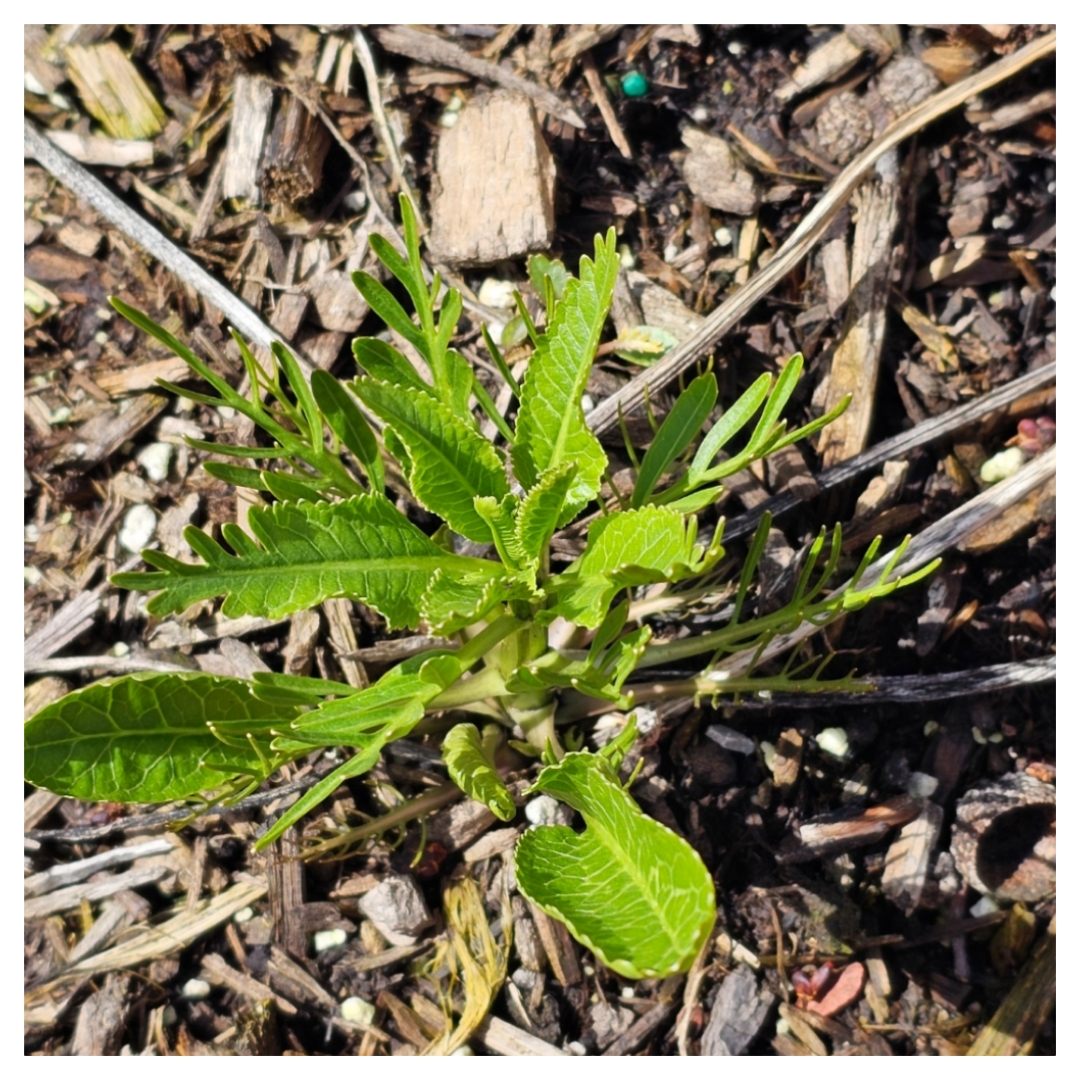
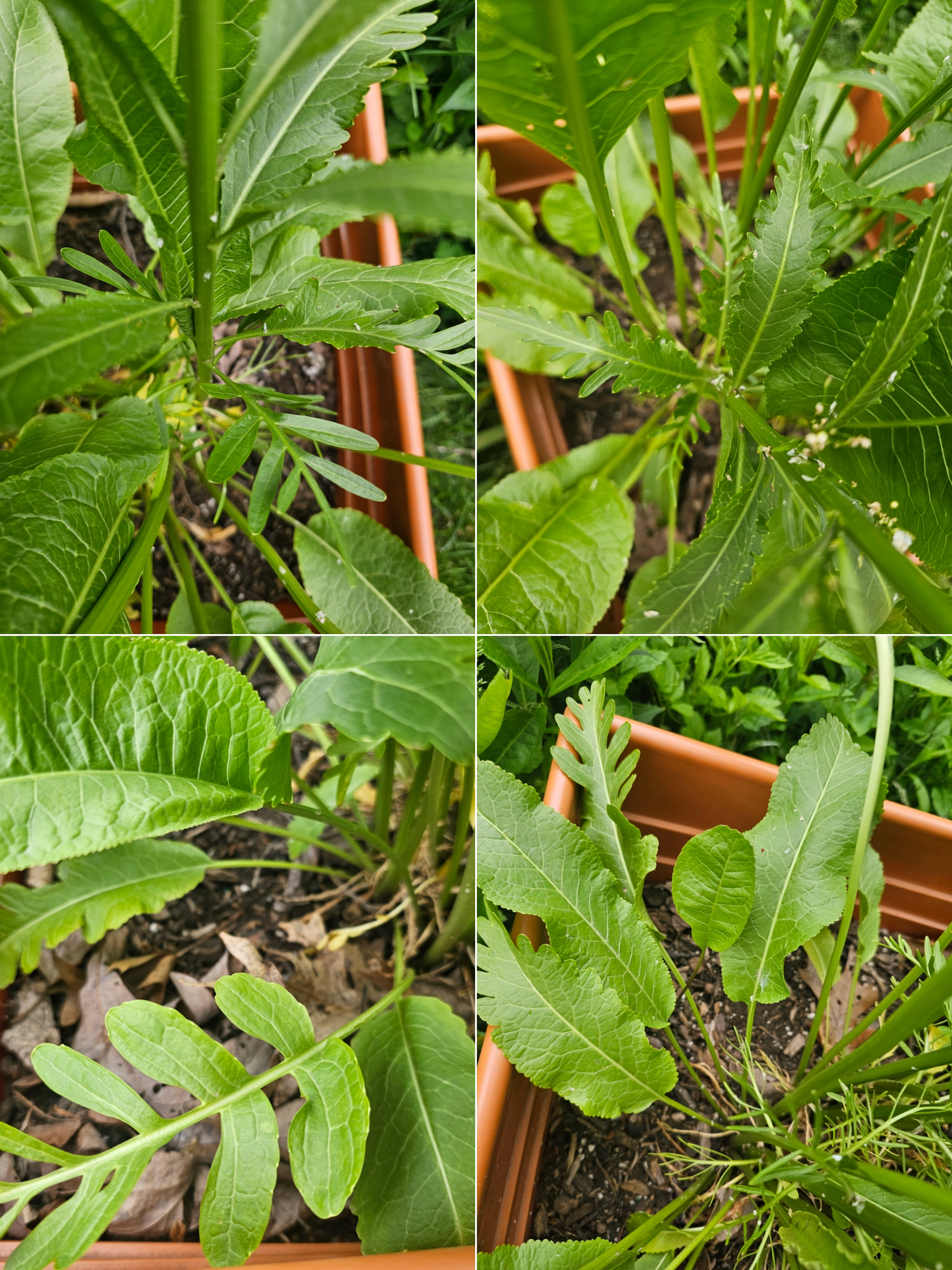
Not long after I started growing Armoracia rusticana plants as ornamental perennials in The RGG’s garden, I noticed that something strange was going on with them. Different leaf shapes were showing up on the same plant. I’m not talking about the leaves on the flower stalk looking different from the leaves in a particular plant’s rosette – those differences in same-plant leaf morphology are a given. What I’m saying here is that all the leaves growing on one single flower stalk on one single plant that should all look the same definitely DO NOT all look the same, and that all the leaves growing in the rosette of one single plant that should all look the same definitely DO NOT look the same.
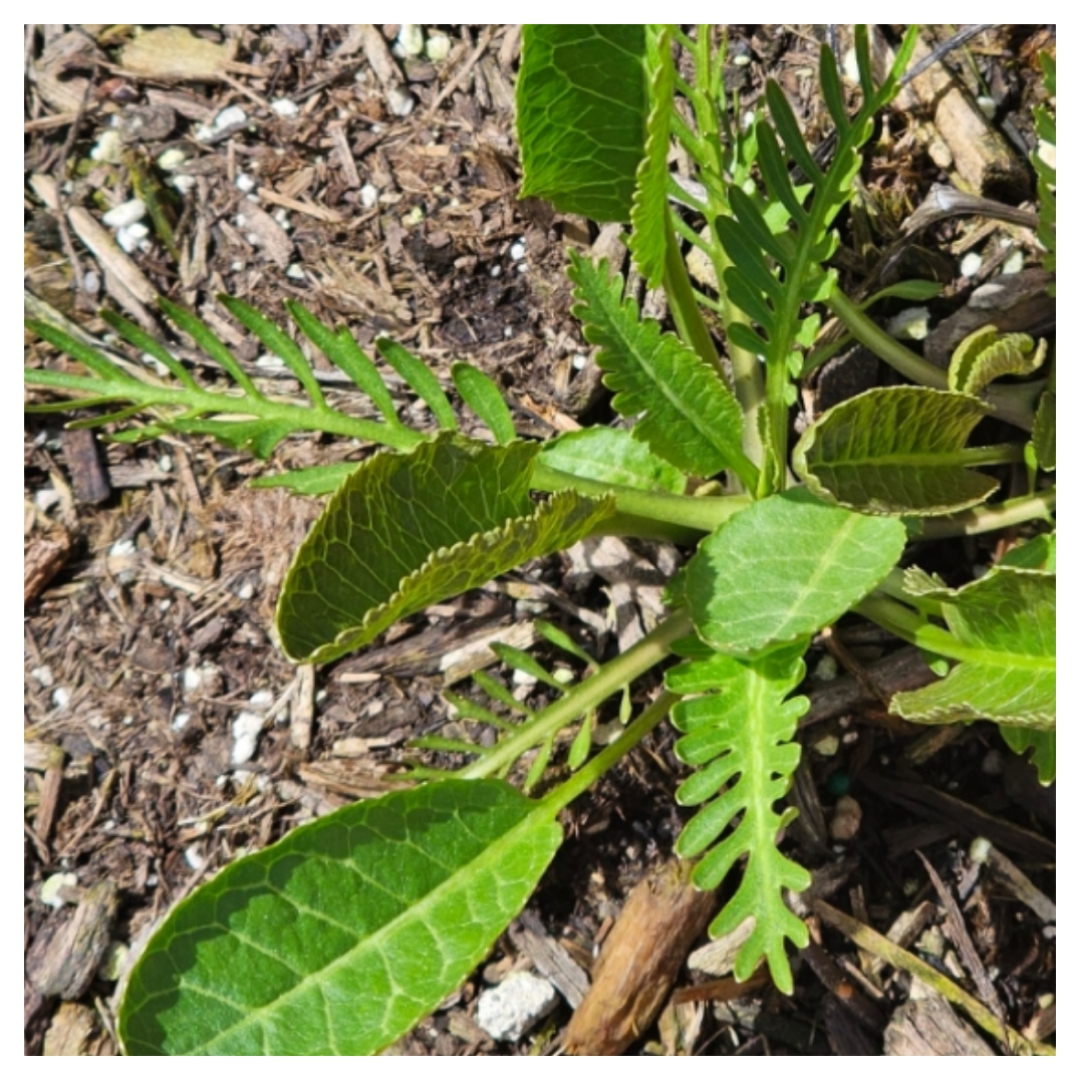
This polymorphic foliar phenomenon (different leaf morphologies on one plant) is known as heterophylly. It manifests itself in the foliage of my horseradish plants and it’s what accounts for both unlobed and lobed (sometimes very deeply lobed) individual leaves growing simultaneously on the same plant.
Heterophylly: What Causes It?
Good question. I’ll equivocate and tell you that some think the answer seems to be fairly clear cut when it comes to aquatic/amphibious plants exhibiting heterophylly, but a little less obvious in the case of this phenomenon occurring in plants that are entirely terrestrial in nature,⁴⁸ e.g., our Armoracia rusticana. I have my own ideas, which have resulted from the observations I’ve made of the horseradish plants that I grow, and which I’ll lay on you shortly. But not before I reference a few interesting studies and their resultant articles/papers, which seem to at least partially back up what I think I’ve been seeing in my own Armoracia rusticana population.
Phytohormones and the environment. Phytohormones are plant hormones that function as signal molecules within a given plant that determine pretty much everything about the way that plant looks, develops, and behaves.⁴⁹ In an excellent review article by researchers at the University of California, Davis and Kyoto Sangyo University in Japan, the role of the phytohormones abscisic acid, ethylene, gibberellins, and auxins influencing heterophylly in aquatic/amphibious plants with respect to environmental factors were examined. In the case of gibberellins (GAs for short) in particular impacting heterophylly (in not just aquatic/amphibious plants, but in terrestrial plants as well), these researchers discovered that changes in ambient temperature and corresponding changes in the concentration of GAs brought about changes in leaf morphology – lower temps/lower GA levels/deeply lobed, and higher temps/higher GA levels/unlobed. They also noted that auxins were present at elevated levels in the tissues of plants (particularly in the polymorphic leaves) of plants exhibiting heterophylly.⁵⁰ (But the dynamic of elevated auxin levels in heterophyllous plants transcends its impact in association with environmental factors as outlined in this study, as you’ll read below in my reference to the next study.)
Hmmm…
Flower/seed development and auxin levels. Researchers in Italy and Germany, in a really fascinating study and corresponding article, demonstrated how changing auxin levels throughout the tissues of a given plant can and do initiate both the growth of certain plant structures (in this case, the plant’s meristem and flowers) and morphological changes throughout its other structures as well. The main point that these righteous cats and kittens make in their article is this: Changing auxin levels throughout the tissues of a plant bring about/are present in morphological changes in that plant. More auxins, more flowering and other morphological changes. Lower auxin levels, termination of flowering/meristem development and remediation/reversal of other morphological changes.⁵¹
Double-hmmm…
Ontogenesis stage and coronal position. In an excellent article by researchers at Tarim University in China, two factors influencing heterophylly in a fully terrestrial plant – the Euphrates poplar (Populus euphratica Oliv.) – were examined. Ontogenesis, which refers to the entire life cycle of a particular plant and all of the molecular, cellular, biochemical, anatomical, and physiological functions (and their changes) it undergoes as it progresses from germination to its death, and coronal positioning, which pertains to the location of a particular plant’s (in this case, the Euphrates poplar, which is a tree) leaves along its height with respect to the surrounding tree canopy, were found to be factors initiating/resulting in heterophylly. Obviously, these factors encompass specifics like reproductive cycles (flowering/seeding and corresponding elevated auxin levels) and changing sunlight and temperature levels (and associate changes in gibberellin (GA) levels) in the cases of ontogenesis and coronal positioning, respectively.⁵² So, does the fact that a plant is entering/experiencing flower/seed production, or that it’s subjected to more/less intense and longer/shorter periods of sun and warmth mean that it’s going to respond by cranking out leaves of different shapes?
Triple-hmmm…
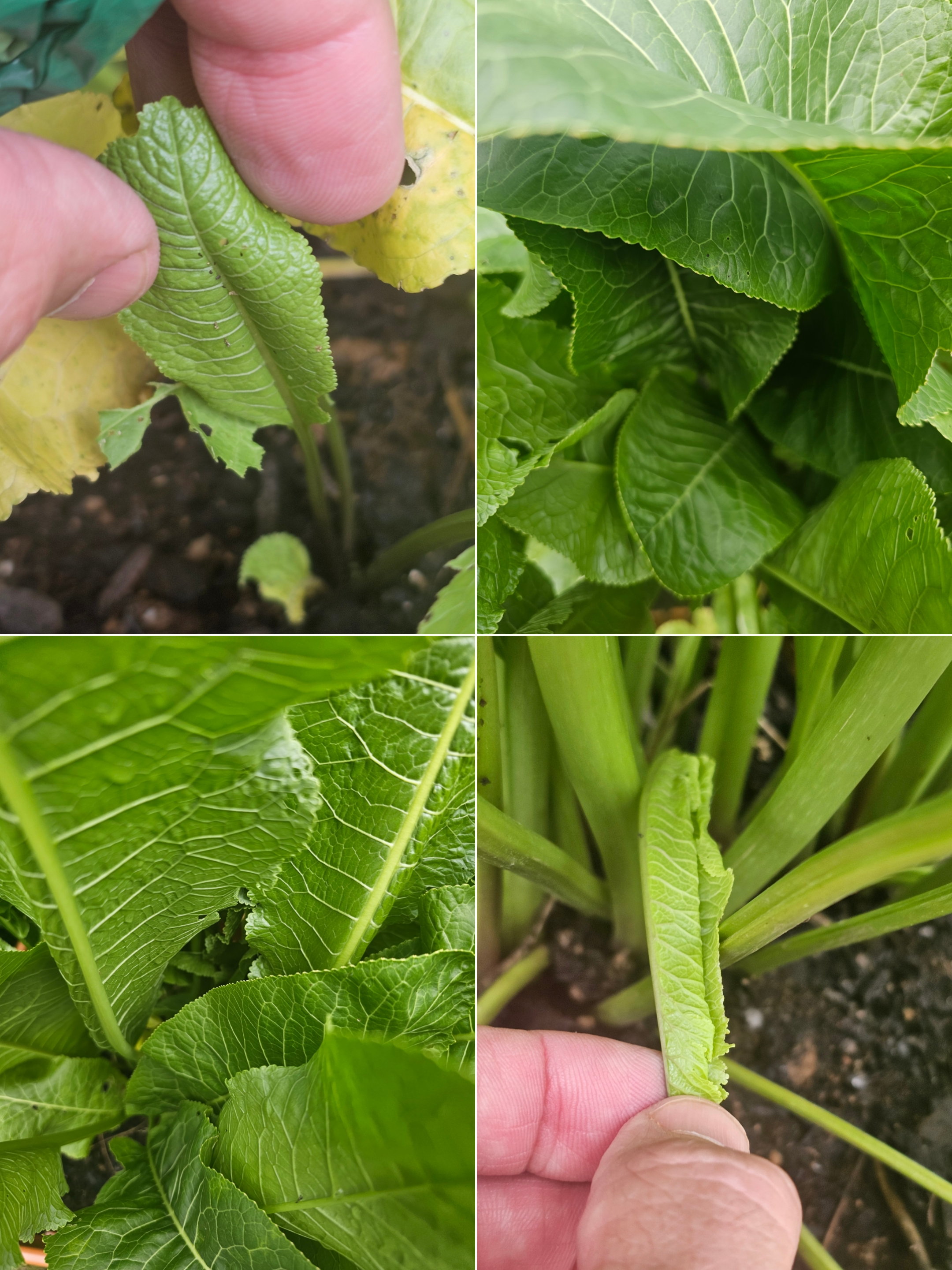
My own horseradish plants and what I think. Here in Hardiness Zone 5B/6A, the temperatures along the late winter-early spring temporal boundary in the second half of March remain quite low. Below-freezing temps are common at night, and can happen periodically during daylight hours. And those late winter/early spring daylight hours (and the warmth they bring), compared to those of the long, hot days of summer, are short. This is the time when my horseradish plants emerge from the soil. When they do, and as they continue to leaf out for the duration of March, throughout April, and into May, they exhibit the leaf polymorphism of heterophylly. Both undissected/unlobed leaves and dissected/very deeply lobed leaves appear in each plant’s rosette, with more of the former and less of the latter. This leaf polymorphism also occurs along each plant’s flower stalks in similar proportion as they develop throughout April and ultimately flower and seed in May. But once ambient temperatures rise during the longer, warmer days of spring and summer, and my horseradish plants’ flowering/seeding is done, the leaf polymorphism of their heterophylly disappears. All new leaves emerge in their true, ovate, undissected/unlobed form.
So…
Do the colder temperatures of late winter/early spring and their corresponding lower levels of gibberellins account for the presence of lobed/deeply dissected leaves among the normal, unlobed/undissected leaves of my horseradish plants? Yes, I think so. And does the presence of elevated auxin levels during my horseradish plants’ flowering and seeding period also result in their heterophylly? That’s another “Yes, I think so.” Does their heterophylly disappear when the weather warms up and when their flowering/seeding stops? You betcha. And how about this: Does my horseradish plants’ heterophylly result from a combination of lower temperatures/lower gibberellin levels and the higher auxin levels associated with these plants’ ontogenetic function of flower and seed production? I’d say that’s for sure the third “Yes, I think so” of the day. Therefore, to sum it all up, I think that environmental influences AND each plant’s ontogenetic functions, AS WELL AS a combination of the two, result in their presentations of heterophylly. I know I’m just a layman, but this is what I’ve seen and this is what I’ve read. So, this is my story and I’m sticking to it.

It's Beautiful, Strange, and Cool, So... Please Don't Eat the Horseradish!
I believe that the Armoracia rusticana should be held in highest esteem as one truly remarkable ornamental perennial garden plant. Its flowers dazzle the eye, perfume the air, and nourish countless beautiful and beneficial pollinators. Its expression of heterophylly from within the profusion of its magnificently strange and glorious foliage is a reminder of the complexity, diversity, mystery, and beauty of all life on this planet. And on a summer’s breeze, it nods and undulates and waves its representation of everything that makes life here so glorious and wonderful. For these reasons, Armoracia rusticana deserves to be admired and appreciated, and its complex and mighty roots, as irresistable as they may be to those with certain masochistic dietary proclivities, should, I feel, remain always belowground.
Are you catching my drift? Good. Then please don’t eat the horseradish, goddammit.
SeedsNow Organic, Non-GMO Seeds, Bare Root Plants, Root Cuttings, and Bulbs
SeedsNow Organic, Non-GMO Seeds, Bare Root Plants, and Bulbs. Regular RGG readers and subscribers will recognize SeedsNow by their banners regularly displayed here. This company is a small, family-owned, customer service oriented purveyor of amazing organic, non-GMO seeds, bare root plants, and bulbs. My experience as their customer has been excellent, and we here at The RGG are proud to call them our affiliate partner. Please click here to read my 2023 RGG article about this wonderful company, and please do click the #advertisement link or any of the SeedsNow banners in this article to visit their website and to view their incredible organic, non-GMO inventory. The ‘Big Top’ horseradish plants featured in this article came to my garden as bare root cuttings from SeedsNow, and I’ve successfully grown such other SeedsNow offerings as asparagus, heirloom tomatoes, artichokes, and Echinacea from seed or from bare root form. I just can’t say enough about SeedsNow and I HIGHLY recommend ordering from them.



Product Recommendations
What would a John Stamos gardening article in The RGG be without an excellent product recommendation or two? Shorter. Ok, I’ll give you that. But also definitely poorer. Particularly in this case. This excellent fertilizer product (along with every other product I recommend here) is one that I use and heartily endorse. Neither I, nor this publication, will ever recommend an unworthy product. The one you’ll read about in the gold Amazon box below is exemplary. The benefits of feeding it to not only my Armoracia rusticana plants, but to countless others throughout my garden as well, are indisputable.
Espoma Organic Plant-tone. I am a huge fan of Espoma’s line of organic fertilizers. Plant-tone is the one I use for the majority of the plants in my garden. It’s got an N-P-K ratio of 5-3-3 and is a great all-purpose organic fertilizer. It works perfectly for an incredibly wide variety of ornamental plants. AND it works perfectly for fruit and vegetable plants too! Again, Espoma Organic Plant-tone is the food that a huge number of my plants get. They love it, and it shows. You can order this product here, directly from Amazon, by clicking the #advertisement link.

References/For Further Reading
Below is this article’s list of cited references/”For Further Reading” list. Each reference is included here in link form, so a simple click or tap will take you directly to any or all of them should your curiosity thus incline you.
(Note: The references as cited are excellent and absolutely correct, though my own composition of some of the citations themselves, and their consistency of format, are a little on the sketchy side. Some are in Chicago format, some are in MLA format, some in AMA, and still others in NLM. Finally, many are in my own format, which is a combination of NFL, MLB, and NBA.)
All kidding aside, there’s some remarkable reading in this list. Please click on any of the links to read what’s there.
- “Armoracia rusticana Gaertn. (Horseradish)”. European Cooperative Programme for Plant Genetic Resources, ecpgr.org, pp. 1-2.
- “Wasabi”. Wikipedia, p. 1.
- Morten E. Møldrup, Bo Salomonsen, Barbara A. Halkier, Chapter Thirteen – Engineering of Glucosinolate Biosynthesis: Candidate Gene Identification and Validation, Editor(s): David A. Hopwood, Methods in Enzymology, Academic Press, Volume 515, 2012, Pages 291-313, ISSN 0076-6879, ISBN 9780123942906, https://doi.org/10.1016/B978-0-12-394290-6.00020-3. (https://www.sciencedirect.com/science/article/pii/B9780123942906000203) Abstract: The diverse biological roles of glucosinolates as plant defense metabolites and anticancer compounds have spurred a strong interest in their biosynthetic pathways. Since the completion of the Arabidopsis genome, functional genomics approaches have enabled significant progress on the elucidation of glucosinolate biosynthesis, although in planta validation of candidate gene function often is hampered by time-consuming generation of knockout and overexpression lines in Arabidopsis. To better exploit the increasing amount of data available from genomic sequencing, microarray database and RNAseq, time-efficient methods for identification and validation of candidate genes are needed. This chapter covers the methodology we are using for gene discovery in glucosinolate engineering, namely, guilt-by-association-based in silico methods and fast proof-of-function screens by transient expression in Nicotiana benthamiana. Moreover, the lessons learned in the rapid, transient tobacco system are readily translated to our robust, versatile yeast expression platform, where additional genes critical for large-scale microbial production of glucosinolates can be identified. We anticipate that the methodology presented here will be beneficial to elucidate and engineer other plant biosynthetic pathways. Keywords: Metabolic engineering; Gene identification; Glucosinolates; Nicotiana benthamiana; Transient expression; Cell factory; Heterologous expression; Pathway elucidation
- “The Pleasure – And Pain – Of Horseradish”. Morehousefoods.com, pp. 1-2.
- Guimaraes MZP, Jordt SE. TRPA1 : A Sensory Channel of Many Talents. In: Liedtke WB, Heller S, editors. TRP Ion Channel Function in Sensory Transduction and Cellular Signaling Cascades. Boca Raton (FL): CRC Press/Taylor & Francis; 2007. Chapter 11. Available from: https://www.ncbi.nlm.nih.gov/books/NBK5237/
- Justin Brower. “A Chemical Explosion in Your Mouth”. Nature’s Poisons, pp. 1-2.
- The Horseradish Information Council. “What Makes Horseradish Hot?”. horseradish.org, p. 1.
- “Colinsville, Illinois”. Wikipedia, p.1.
- “The Horseradish Capital of the World”. jrkelly.com, p. 1.
- “Collinsville, Illinois”. Wikipedia, p. 6.
- “Armoracia rusticana Gaertn. (Horseradish)”. European Cooperative Programme for Plant Genetic Resources, ecpgr.org, pp. 1-2.
- “Horseradish”. Wikipedia, p. 3.
- “Horseradish”. Wikipedia, p. 1.
- “Armoracia“. Wikipedia, p. 1.
- Dubyna D.V., Zhmud O.I. “Armoracia macrocarpa (Brassicaceae) in the Ukrainian part of the Danube valley”. Ukrainian Botanical Journal, pp. 1-2.
- “Armoracia sisymbrioides“. Royal Botanic Gardens, Kew Plants of the World Online, pp. 1-6.
- “Horseradish”. Oregon State University, College of Agricultural Sciences, Department of Horticulture, Oregon Vegetables, pp. 1-2.
- Sarah Browning. “Horesradish”. University of Nebraska – Lincoln, Institute of Agriculture and Natural Resources – Nebraska Extension in Lancaster County, lancaster.unl.edu, July 17, 2022, p. 2.
- “Horesradish”. 2026/2027 Mid-Atlantic Commercial Vegetable Production Recommendations, Rutgers University Cooperative Extension, New Jersey Agricultural Experiment Station, April 23, 2026, p. 269.
- Janeen Wright. Christine Thompson. “The Herb Society of America’s Essential Guide to Horseradish”, p.13.
- “The Background of Horseradish”. Dennis’ Horseradish, dennishorseradish.com, p. 1.
- Walters SA. Review of Horseradish Breeding for Improved Root Quality and Yield in Illinois, USA. Agronomy. 2021; 11(1):175. https://doi.org/10.3390/agronomy11010175
- “Zygosity”. Wikipedia, p. 2.
- “Armoracia rusticana Gaertn. (Horseradish)”. European Cooperative Programme for Plant genetic Resources, ecpgr.org, p. 1.
- “Horseradish”. Wikipedia, p.1.
- “Horseradish History”. The Horseradish Information Council, HORSERADISH.ORG, P. 1.
- J. W. Courter, and A. M. Rhodes. “Historical Notes on Horseradish.” Economic Botany, vol. 23, no. 2, 1969, pp. 156–64. JSTOR, http://www.jstor.org/stable/4253036. Accessed 19 May 2026.
- “Dioscorides”. Wikipedia, pp. 1-2.
- “Cato the Elder”. Wikipedia, p. 11.
- “De agra cultura“. Wikipedia, pp. 1-4.
- Britannica Editors. “Marcus Porcius Cato”. Encyclopedia Britannica, 10 Mar. 2025, https://www.britannica.com/biography/Marcus-Porcius-Cato-Roman-statesman-234-149-BCE. Accessed 23 May 2026.
- “Ostia Antica”. Wikipedia, pp. 2-4.
- Stephan T.A.M. Mols. “The wall paintings of Ostia – staus quaestionis and future prospects”. Bulletin of Ancient Civilization, 77, (2002), 151-174
- “4 Health Benefits of Horseradish”. Cleveland Clinic Health Essentials, July 8, 2024, pp. 1-3.
- Janeen Wright. Christine Thompson. “The Herb Society of America’s Essential Guide to Horseradish”, p.5.
- “Maror”. Wikipedia, pp. 1-2.
- Eli Landes. “Maror: The Bitter Herbs”. chabad.org, pp. 1-2.
- “John Gerard”. Wikipedia, pp. 1, 3, 4.
- “The Herball, or, Generall historie of plantes 1636“. Royal Collection Trust, pp. 1-3.
- Phillips, Henry (1822). History of Cultivated Vegetables. H. Colburn and Co. p. 255. ISBN 978-1-4369-9965-6.
- “Horseradish History”. The Horseradish Information Council, HORSERADISH.ORG, P. 2.
- Anthony Bratsch. “Specialty Crop Profile: Horseradish”. Virginia Cooperative Extension, Publication 438-104, pp. 2-4.
- “Edible Garden Featured Plant: Horseradish”. Bernheim, bernheim.org, October 8, 2021, p.2.
- “Horseradish”. Illinois Wildflowers, illinoiswildflowers.info, p. 1.
- Walters SA. Horseradish Breeding. Encyclopedia. Available at: https://encyclopedia.pub/entry/7403. Accessed June 15, 2026.
- “Growing Horseradish (Armoracia rusticana)”. whiteflowerfarm.com, Garden Help, p.1.
- Margaret Boyles. “How to Grow Horseradish: Plant, Grow, and Harvest This Spicy Root”. Almanac, May 28, 2026 (rev.), p. 5.
- Anke Bebber. “Heterophylly: One Plant – Different Leaves”. Flora Incognita, July 18, 2023, pp. 1-3.
- “Plant hormone”. Wikipedia, pp. 1-7.
- Nakayama H, Sinha NR and Kimura S (2017) How Do Plants and Phytohormones Accomplish Heterophylly, Leaf Phenotypic Plasticity, in Response to Environmental Cues. Front. Plant Sci. 8:1717. doi: 10.3389/fpls.2017.01717
- Cucinotta M, Cavalleri A, Chandler JW, Colombo L. Auxin and Flower Development: A Blossoming Field. Cold Spring Harb Perspect Biol. 2021 Feb 1;13(2):a039974. doi: 10.1101/cshperspect.a039974. PMID: 33355218; PMCID: PMC7849340.
John Stamos is a writer and is co-publisher of The Renaissance Garden Guy. His work has appeared in a number of publications including, most recently, A Man for Some Seasons, Splice Today, and, of course, The Renaissance Garden Guy. He is married to his multitalented sweetheart, the mycologist and writer Ann Simpson-Stamos.


The Renaissance Garden Guy is a participant in the Amazon Associates Program. As an Amazon Associate, The Renaissance Garden Guy earns from qualifying purchases.
Additionally, The Renaissance Garden Guy is a participant in the Bluehost, SeedsNow, and Hosting.com (formerly A2 Hosting) affiliate programs. The Renaissance Garden Guy earns a fee/commission each time a visitor clicks on an ad or banner in this site from one of these companies and makes a subsequent qualifying purchase.
Please click here to view The Renaissance Garden Guy Disclosure page.



WOW!!!!
Never knew that Horseradish was indeed such a fantastic plant… Definitely the emerald-green leaves mixed with white flowers makes it such a beautiful plant to add to a garden 🪴
Thanks for reading the article, Roxxy. I know it was a long one, and I’m really glad you found it interesting. Up until the first time I saw one of these flowering, I had only limited knowledge of it. But I thought it was beautiful, and the flowers smelled SO amazing… Once I figured out what a remarkable, glorious plant it was (did some research and checked out lots of photos of it), I knew I wanted to grow horseradish for myself as an ornamental plant. I just LOVE these things! Thanks again for reading the article, Roxxy, and thank you so much for your kind words. I really appreciate it.
Great article about a very interesting plant. I love growing these plants – they make such a fabulous addition to my own ornamental perennial garden. And I do grow them in containers to keep them reined in. I love and admire mine for their beauty, so I obviously never harvest them. The stuff I slap on my food comes in a jar from the supermarket.
So, you let someone else murder the horseradish plants, do you? I get it. I do the same thing. Prepared horseradish rocks. The hotter the better! But, like you, I would never harm a hair on my own horseradish plants’ roots. They’re like part of the family. Thanks for reading the article, Kevin, and for commenting here. Much appreciated!
I still remember from my childhood the red jar of horseradish that was always on hand for so many of our meals. I never stopped to wonder about where it came from, or even about the beautiful plant that was its source. The history of horseradish was particularily fascinating. This article is excellent, and I loved it.
Thank you so much for reading the article, Jo, and for your lovely thoughts and comments. I originally decided to buy some bare root cuttings because I saw the mature, flowering plants in a catalog and fell in love with them. They’re really beautiful plants. I decided I had to learn more about them once I saw those differently-shaped leaves appearing on the same plant. Researching the plant’s history and biology has been a lot of fun and very interesting. I’m so happy that you enjoyed reading about these remarkable plants. Thanks once again, Jo. I really appreciate that.
I never realized how much there was to learn about Horseradish until I read your article. The plant itself is also very attractive.
Thanks for reading it, Rick. I appreciate your interest in the subject. When I first started growing these things, I was attracted to their qualities as ornamental perennial plants (the wild foliage, pretty and fragrant flowers, hardiness, etc.). I was always a bit curious about their history, taxonomy, etc. But what really got me going on the research was their presentation of heterophylly (varying leaf morphology in a single plant). Studying them has been a blast. Thanks again for reading this one, Rick, and for commenting here. I’m very grateful.
Wow! There is so much information here that I need to go back and read sections again in detail. Fascinating! I might try to grow horseradish now that I’ve seen this!
Thanks, Lisa. I appreciate your sticking it out. I know it was a long one. The horseradish plant is actually very lovely, and it’s worth some definite consideration as an ornamental perennial. I really do love mine, and couldn’t bear the thought of digging them up and eating them. Thanks again for reading the article, Lisa, and for your kind comments. I really appreciate it.